Wednesday, May 28, 2008

The Butch Caucus

intro to the butch caucus

Between work, some different celebrations, all the other stuff we do, and getting ready for THE CLASS, I haven't had a second to write (much less sleep)... on top of all that, a good friend and fellow blogger found her way back in to town for a few weeks - and just as i'm getting ready to be in and out for a minute :-(

In honor of her triumphant return to NYC, check out the butch caucus and her first vlog above. We have a pending zine collaboration that just may come to fruition one of these days, but in the meantime...

Class begins in a week, so rest up and I'll see you next Wednesday at the Brecht Forum!

Read More!

Wednesday, May 21, 2008

Wednesdays in June


Even if you have read everything on this website, I strongly encourage you to BE A PART OF THIS CLASS! It's gonna be a totally different, engaging, exciting experience...

ENTER THE INTERGALACTIC!
Zapatismo in the US and the World


Wednesdays in June
from 6:30 pm - 8:30 pm
at the Brecht Forum

4-SESSION CLASS BEGINS ON JUNE 4TH...

Since their January 1st, 1994 armed uprising in Southeastern Mexico, the zapatistas have consistently reached out to people from around the world to join them in building a global network “for humanity and against neoliberalism." This network is sometimes referred to as the "Intergalactic"...

Whether you feel like you know a lot or just a little about the zapatistas, this class is designed to meet each participants needs AND ENGAGE ALL in a meaningful exploration of what it means to fight for a better world in these times.

These are some of the questions we will explore:

I) What is the Fourth World War and what does it mean for how we struggle today?

II) What is the zapatistas' Sixth Declaration of the Lacandon Jungle?

  • What has happened since its release in the summer of 2005?
  • How do its initiatives for transnational (Other Campaign) and global (Zezta Internazional) coordination compare to other processes, such as the World Social Forum?
III) What are OUR analyses of the zapatistas' Fourth World War framework, their Sixth Declaration and the initiatives that have followed... and how do we relate to them?

Tuition is a sliding scale $45-$65... with all proceeds going to sustaining the Brecht Forum. And it's FREE for Brecht Forum Subscribers!

The class will be facilitated by RJ Maccani, an organizer with Regeneración Childcare NYC and author of the blog Zapagringo.

Read More!

Monday, May 19, 2008

Simón Sedillo on Solidarity

Billboard in Mexico. This image is seen from one of the main roads in Oaxaca.

Here's another piece on solidarity (and check out the just updated Zapatismo and Solidarity from two weeks ago)...

Standing With Those Who Fight for Themselves
by Simón Sedillo
Originally published in the Summer 2008 issue of ¡Presente! - newspaper of SOA Watch

Neoliberals believe that somehow they have finally discovered a socially responsible, or socially democratic, way of taking people’s land, labor, and resources by force, for profit.

It’s not possible. This is the myth of neoliberalism. This imposed political economy reduces human beings and natural resources into variables in an economic equation. Every day the human variable in this equation is considered more expendable. Indigenous people, farm workers, women, youth, and poor people everywhere are reduced to variables in this equation. When no longer considered economically viable by the powers that be, communities become economically expendable. If a group of people can be treated as disposable for “not fitting in,” imagine how that group is treated when they organize or resist this imposition. Historically they have been treated as a virus which must be eliminated.

This is the same kind of genocide upon which the United States of America was founded. Somehow most U.S. citizens have managed to detach themselves from their nation’s history to the point of ignoring its present. Native children were still being put in “boarding schools” by the U.S. Army just over 70 years ago. The School of the Americas has made a science out of terrorizing communities in resistance throughout Latin America. The most conservative estimate provided by the Iraqi Health Ministry, claims a total of 151,000 violent deaths from March 2003 through June 2006.

When we think about military occupation, we think about Iraq, Afghanistan, and Palestine. Military occupation is the most blatant form of imposing a political economy, but neoliberalism includes much more than military occupation. Neoliberal occupation is imposed politically, economically, socially, culturally, psychologically, and spiritually. It is the imposition of a global consumer monoculture, where in places like Mexico, it is primarily white people who are the protagonists of every billboard, commercial, soap opera, or news report. Indigenous-ness is devalued to the point of being shamed into a deathly silence.

What once was easily-identifiable militarism in Central America has devolved into the para-militarization of indigenous communities through out southern Mexico. In Oaxaca, many of the atrocities committed against indigenous communities are disguised as agrarian land disputes between neighboring communities. Some are orchestrated well enough to confuse the very paramilitaries of their role in this systematic form of state-sponsored repression. The disputes can be between different tribes, the same tribe, and mestizos. These strategies are not new, just a continuation of dividing then conquering.

The greatest threat to the national security of the United States has always been grassroots, community-based organizing for self-determination, people sharing the idea that they are capable of taking care of themselves. That is the threat Native Americans posed, and the threat that the people of Oaxaca, like many others, continue to pose. In 2005-2006 the Department of Geography at Kansas University in Lawrence, Kansas received a $500,000 grant from the Department of Defense to map communally-held indigenous lands in Oaxaca, Mexico. The Foreign Military Service Office (FMSO) at Fort Leavenworth is providing the grant money. Fort Leavenworth was the epicenter of westward expansion by the U.S. into Native territory. Today the FMSO assesses “asymmetric” and “emerging” threats to the national security of the U.S. Asymmetric threats are defined as guerrilla armies and terrorist organizations, while emerging threats are clearly being defined as social movements.

The first step in standing in solidarity with people who fight for themselves is understanding that their fights are considered threats to the powers that be.

Today we face “Imperial activism,” the idea that activists know better than the communities with whom they stand in solidarity. U.S. citizens have, in particular, harnessed this notion of “empowerment” of women, people of color, the indigenous, workers, youth or other groups. This notion of empowerment places power in the hands of the activist and negates the power of the people who are resisting for themselves.

This dynamic validates charity and not solidarity. Real solidarity is more about sharing, collaborating, and contributing to self-empowerment, as opposed to feeling good about handing out some aid. It is important to learn first, before teaching anything. Many indigenous communities have centuries of resistance to share and teach. The best way to walk or move forward in solidarity is by asking first about what may be needed or what may be a problem. Walking by asking, then teaching by learning.

To this end, I can only testify to my experience as a Chicano community-based organizer who chose to stand in solidarity with the people of Oaxaca. In 2005, in collaboration with Austin Indymedia, I finished an Oaxaca solidarity film called “El Enemigo Común.” After production the compas in Oaxaca made it clear that they wanted to learn how to shoot and edit video themselves. I had to learn what I could and should teach, and why I should teach that. In my case I had to learn how to edit video, then how to teach this skill.

I started as a solidarity activist but ended up a teacher and, most importantly, a student. I learned a lot about my privilege to learn and my responsibility to teach. In the United States I could learn video and audio to teach in Oaxaca. There, in turn, I could learn about methods of community-based organizing and teach about them in my community here.

Residents of the U.S. have more to learn than teach. The peace in which many U.S. residents believe is a lie. There can be no peace without dignity, justice, and liberty for everyone, everywhere. The more that people in the U.S. believe in this false peace, the more they validate its means: terror.

In 2002, at a farmworker sit-in at the state capitol in Oaxaca City, a compa leaned over to me and said, “Do Americans not realize that their peace is our terror? And if they did, would they care?” This peace has been and continues to be built on the back, sweat, and blood of others. To truly stand in solidarity with the many others fighting for themselves everywhere, people in the U.S. who care about justice have to challenge their ideas about peace. What are you willing to sacrifice for others to have peace as well? True solidarity comes from sacrifice, the recognition of privilege and the responsibility that comes with that privilege. We must be accountable to the whole of humanity at all times, not just to those we choose when it is convenient to do so.

Read More!

Tuesday, May 13, 2008

Stop Plan Mexico - TODAY!

UPDATE Jun 14 '08: the fate of Plan Mexico is still in play...

UPDATE Mar 22 '08: Plan Mexico Passed in the US House of Representatives... bad news, REALLY bad news. In other news, SOA Watch has won a victory in the House and the Coalition of Immokalee Workers have brought another fast food giant, Burger King, to the table.

---------------------------------------------------------
Hey Friends - Call your Congressional Representatives and Howard Berman, Chair of the House Foreign Affairs committee ASAP to Stop Plan Mexico. All the information you'll need is below.

Also, I've got a whole lot of good stuff coming soon, including some original pieces and an update on the post below, but I'm just waiting for the final drafts to come thru... stay tuned! And if you are in NYC: Sign up now for the "class" I'll be leading every Wednesday in June from 6:30 to 8:30p at the Brecht Forum entitled "Enter the Intergalactic! Zapatismo in the US and the World" - it'll be mind-blowing and explorational, but only if you sign-up!

Urgent: Stop "Plan Mexico"

from Witness for Peace

Congress to vote this week on Merida Initiative

As early as tomorrow,
Congress will vote on a bill
to continue funding two failed wars:
Iraq and the "war on drugs."

This week Congress will likely vote on a supplemental appropriations
bill dominated by Iraq war funding. The bill, in addition to pouring
billions more into the devastating occupation of Iraq, would include
the notorious Merida Initiative. This security assistance package,
popularly dubbed "Plan Mexico," would provide hundreds of millions of
taxpayers' dollars to Mexican and Central American security forces in
the name of combating drug trafficking and crime. Proposals thus far
would spend the bulk of the money on military equipment for Mexican
forces known for consistent human rights violations.

We at Witness for Peace know that arming foreign militaries will not
solve our drug problem, a fact now painfully obvious in Colombia.
After eight years and over five billion dollars of Plan Colombia, the
massive anti-drug experiment has failed remarkably. The single goal of
U.S. drug policy in Colombia was to see a 50 percent reduction in the
production of coca, the raw material for cocaine. Today there is as
much coca growing in Colombia as there was the year Plan Colombia
began. There is no reason to believe that sending helicopters to stop
drug traffic in Mexico will work any better than sending helicopters
to stop drug production in Colombia. Let's learn from our mistakes
instead of repeating them. (For further background and analysis
please see the talking points below.)


TAKE ACTION: The Time is Now!
To prevent passage of this senseless military package, we need to
pressure our Congressional representatives NOW. With the vote just
days away, this may be our last opportunity to stop it.

Call the offices of your representatives and ask that the Merida
Initiative funding be eliminated from the supplemental appropriations
bill. Use the talking points below. To reach your representatives'
offices, call the U.S. Capitol Switchboard at 202-224-3121. Ask to be
connected to your House or Senate member (give your state and zip code if you're not sure who it is).

Call the office of Howard Berman, Chair of the House Foreign Affairs
committee, to say you oppose authorization of the Merida Initiative:
202-225-4695. If your representative is on the committee, also ask
them to oppose Berman's steps towards authorization. Click here to
find out if your rep is a member.


Talking Points for Opposing the Merida Initiative

A. The initiative would not effectively combat drug-trafficking

The Merida Initiative would fail to have a lasting impact on drug
trafficking for three key reasons:

1. Military interdiction efforts have a "balloon" effect. In
Colombia, U.S. military efforts to stop coca production and
trafficking in key locations have simply shifted production and
trafficking to new locations. The resulting proliferation is evident:
the number of coca-producing states in Colombia has jumped from 8 to
24 over the course of Plan Colombia. The Merida Initiative would
likely have a parallel effect on drug trafficking. As stated by the
Centro Pro, a national human rights organization in Mexico City,
"History has proven time and time again that such law enforcement
efforts merely divert trafficking routes, creating a geographic
shuffle of social and criminal problems."

2. The Merida Initiative ignores a root cause of the problem: U.S.
demand. Widespread drug use in the U.S. makes drug trafficking a
lucrative business. Colombia has taught us that so long as demand
remains high, even a multi-billion dollar military solution will
fail. Even the right-wing RAND Corporation has concluded that far-
flung attempts to stop drugs at their source is 23 times less cost
effective than domestic drug treatment at home. Yet, according to the
current budget, the Merida Initiative destines not a single penny of
its funds to state-side drug demand reduction programs.

3. The Merida Initiative model also fails to recognize poverty as
another root cause of drug trafficking. Fifty million people in
Mexico live in poverty, creating conditions for intense migration and
powerful black markets. Minimum wage is barely five dollars per DAY,
which is by all standards unlivable, and many people don't even make
that. The U.S. has played a role in shaping this desperate reality
through structural adjustment and trade policies that have exacerbated
unemployment and added to the cost of living for many. So long as
such poverty persists in Mexico, some Mexicans will continue to choose
drug-running as a lucrative alternative to migration or unemployment.
So long as the U.S. implements policies that perpetuate Mexico's
poverty, it will be working at odds with its own counter-narcotics
initiatives.


B. The initiative further threatens human rights

Numerous Mexican and international human rights organizations
have expressed concern that counter-narcotics aid for Mexico's
military and police constitutes a recipe for unchecked human rights
violations. According to Centro Pro, "Past experience has shown
policies like the Merida Initiative to be financially costly and to
broaden the mandate of military operations, violating the human rights
of civilians, all the while failing to achieve sustainable gains in
human security." At root is the fact that counter-narcotics
operations in Mexico have a recorded history of human rights abuses.
Amnesty International reports that over the last decade it has
documented "abuses committed by military personnel in counter-
narcotics operations in Chiapas, Guerrero, Oaxaca, Tamaulipas and
Coahuila." Espacio Civil, a civil society coalition comprised of 52
Oaxacan organizations, adds that in 2007 "the army committed severe
human rights violations in their supposed counter-drug operations. We
are concerned that the funding from the U.S. government will
ultimately make this situation worse."


C. The initiative could likely be used to suppress
legitimate political expression

Many Mexican groups fear, with good reason, that the US military
hardware and training in the Merida Initiative would be used directly
against citizens participating in acts of legitimate political
expression. Mexican military and public security forces have
consistently been deployed to stop and often brutally repress popular
protest. Perhaps the most alarming example of late is the crackdown
of the Oaxacan social movement that began with a teacher's strike in
2006. Both federal and state security forces brought an iron fist
down on the demonstrations, leaving a wake of human rights violations
that include over 20 assassinations (including U.S. journalist Brad
Will), hundreds of arbitrary detentions, and torture. The cases
against the security forces, which have been well documented by
Amnesty International and the Inter-American Commission on Human
Rights, remain unresolved in Mexico. A sizeable portion of the money
from the Merida Initiative would support the very security forces
responsible for these violations. Many in Oaxaca fear that with this
support, legitimate protest in Mexico will continue to be answered
with repression.

Our representatives urgently need to know what you now know. Please
do not delay in contacting them. Thank you for calling for a more
just U.S. policy towards Mexico. Feel free to contact the Mexico team
with questions (mexico@witnessforpeace.org).

WFP Mexico
Witness for Peace
202-547-6112
www.witnessforpeace.org

Read More!

Monday, May 05, 2008

Zapatismo and Solidarity


“Be A Zapatista Wherever You Are”
Learning Solidarity in the 4th World War
By RJ Maccani
for the upcoming issue of the RESIST Newsletter

Behind our black mask, behind our armed voice, behind our unnameable name, behind what you see of us, behind this, we are you. – Major Ana Maria of the Zapatista Army of National Liberation (EZLN) at the First Intercontinental Encuentro for Humanity and Against Neoliberalism. Chiapas, Mexico. 1996.

In their words and in their actions, Mexico’s zapatista rebels have developed and propagated a powerful conception of solidarity. Through exploring a bit of their history, as well as the work of several of their supporters and allies within the USA, I seek to share here some of my understandings of what solidarity means to the zapatistas and, thus, what it might mean for those of us who seek to act in solidarity with them.

Everything for Everyone, Nothing for Ourselves

Perhaps the EZLN got lucky when they picked January 1st, 1994 to be the day they would rise up in arms. As the prominent Mexican intellectual Gustavo Esteva describes it, there wasn’t much else happening at the time:

Not a plane crashed. No tsunami came. No princess died. No president had any sexual escapade. Nothing happened on earth. The media was empty. They had nothing to present us. So, on January 2, we had a thousand journalists in San Cristobal. CNN was projecting Zapatistas. We had beautiful images with the ski masks and all the emotion. It was perfect for the news. Six hours a day, CNN was presenting Zapatistas.

From Mexico’s southeastern state of Chiapas, the zapatista cry of “¡Ya Basta!” (“Enough is Enough!”) quickly traveled around the globe not only through the corporate media but, unfiltered and direct, over the Internet as well. A virtual army of volunteer translators and web-junkies ensured that anyone who wanted to could engage directly with the communiqués, stories and letters of the zapatistas. In the same moment that the North American Free Trade Agreement went into effect, the EZLN –in image and word- and the poverty of southern Mexico were catapulted into the consciousness of people around the world.

Although they succeeded in liberating over a million acres of land from plantation owners in the first days of the uprising, the zapatistas’ rag tag army of poorly equipped peasant soldiers could never have dreamed of matching the violence of the Mexican military. Demanding “work, land, housing, food, health care, education, independence, freedom, democracy, justice and peace,” they called on their fellow Mexicans to join them by rising up in arms to depose the one-party rule of the PRI (Institutional Revolutionary Party). In response to this call, the zapatistas instead found themselves confronted by a global “civil society” that echoed their demands but sought to achieve them through nonviolent means. That the zapatistas were not annihilated by the Mexican Army has less to do with their military prowess and more to do with the hundreds of thousands of people who flooded the streets of Mexico City and other cities around the world in support of peace.

Taking a cue from the people they had hoped to lead into battle, the Zapatistas decided to stop speaking with “the fire” in order to strengthen the path of “the word”. And so in the 14 years since the uprising, the zapatistas have hosted countless consultas (mass consultations), encuentros (gatherings for listening and speaking), and other engagements with various segments of a national and international “civil society” that was attracted to them and who the zapatistas recognized as their peers. As Subcomandante Marcos, the spokesperson of the zapatistas, remarked in a recent interview,

…it so happened that we, the EZLN, were almost all indigenous from here in Chiapas, but we did not want to struggle just for our own good, or just for the good of the indigenous of Chiapas, or just for the good of the Indian peoples of Mexico. We wanted to fight along with everyone who was humble and simple like ourselves and who was in great need and who suffered from exploitation and thievery by the rich and their bad governments here, in our Mexico, and in other countries in the world. [emphasis added]

Since their public emergence, the zapatistas have sought to sustain an open and non-vanguardist style, communicated through the aphorisms “Walking, we ask questions” and “Lead by obeying.” Their commitment to struggling not just for themselves, but for all of humanity, is expressed powerfully and clearly in their “Everything for everyone, nothing for ourselves.”

Breaking the “Cinderella Syndrome”

Seeking dignity in their struggle, the zapatistas have sought allies in the form of compañeros. "Compañeros" is a word for which I’ve found no equivalent in English that, taken literally, suggests “people with whom you share bread.” The zapatistas have found, however, that some supporters have been unable to break with their own solidarity frameworks based on pity and charity. With playful style, Subcomandante Marcos described this as the “Cinderella Syndrome”:

We are not reproaching you for anything (to those from civil society who came to the communities), we know that you are risking much to come and see us and to bring aid to the civilians on this side. It is not our needs that bring us pain, it's seeing in others what others don't see, the same abandonment of liberty and democracy, the same lack of justice. From what our people received in benefit in this war, I saved an example of "humanitarian aid" for the Chiapaneco indigenous, which arrived a few weeks ago: a pink stiletto heel, imported, size 6 1/2 without its mate. I always carry it in my backpack in order to remind myself, in the midst of interviews, photo reports and attractive sexual propositions, what we are to the country after the first of January: a Cinderella. These good people who, sincerely, send us a pink stiletto heel, size 6 1/2, imported, without its mate, thinking that, poor as we are, we'll accept anything, charity and alms.

Through their paternalistic behavior, some international aid agencies and NGOs were also diagnosed with this “Cinderella Syndrome.” So in the Summer of 2003, the Zapatistas officially announced the creation of the "Caracoles" and Good Government Councils, structures through which their over 40 autonomous municipalities, grouped into five regions, could, amongst other things, filter and coordinate collaboration with supporters in a more organized, dignified way.

The Fourth World War

The Zapatistas’ desire to build dignified relationships of mutual aid and collaboration with their supporters is reinforced by their analysis of the current conditions that we all face in the struggle for a better world. The struggle today is referred to by the zapatistas as the Fourth World War. In this analysis, the Third World War was the Cold War, in which a group of nation-states (the United States and NATO) defeated another group of nation-states (the Soviet Union and the Warsaw Pact) for control of discrete territories (Central Africa, Southeast Asia, and Central America). As El Kilombo Intergaláctico, a people of color collective in Durham, North Carolina explains it in their book, "Beyond Resistance: Everything":

…the Fourth World War is a war between what the EZLN has termed the “Empire of Money” and humanity. The main objectives of this war are: first, the capture of territory and labor for the expansion and construction of new markets; second, the extortion of profit; and third, the globalization of exploitation. Significantly then, for the first time, we are in the midst of a World War that is not fought between nations or even between a nation and an externally identifiable enemy. It is instead a war for the imposition of a logic and a practice, the logic and practice of capital, and therefore everything that is human and opposes capital is the enemy; we are all at all times potentially the enemy, thus requiring an omniscient and omnipotent social policing. As the EZLN explains, this qualifies the Fourth World War as the first truly TOTAL war because, unlike even the Third World War, this is not a war on all fronts; it is the first world war with NO front.

This understanding of the threat we are facing today means that none of us have the privilege of standing “outside” of the conflict, content to lend our charitable solidarity to those struggling within the trenches.

The Sixth Declaration

Building off the strength of their Caracoles and Good Governance Councils, formally established in the summer of 2003, the zapatistas released their Sixth Declaration of the Lacandon Jungle two years later. The Sixth Declaration, like the five that have preceded it since their 1994 uprising, announced the major steps the zapatistas would be taking in their next phase of struggle. In the case of the Sixth, they announced that they were seeking to actively build a national movement to liberate Mexico “from below and to the left” and to build more relationships of mutual support and respect with people and movements around the world “fighting against neoliberalism and for humankind.”

Groups from around the world responded to the zapatistas’ Sixth Declaration, amongst them were many groups from within the USA whose practices highlight many of the different ways that their supporters have taken to heart the old zapatista suggestion to “Be a Zapatista wherever you are":

The Coalition of Immokalee Workers (CIW), made up of over 2,500 largely Latino, Haitian, and Mayan Indian immigrants working in low-wage jobs throughout the state of Florida, are perhaps one of the best known adherents to the Sixth Declaration. The connection may not seem clear at first because the CIW is not anti-capitalist, for example, or pursuing an autonomous path to change. Something they do share with the zapatistas, however, is an openness and respect for their supporters that stimulates active engagement and innovation. An even deeper connection is the fact that the CIW and the zapatistas may, in fact, share overlapping membership. When Melody Gonzalez of the Student/Farmworker Alliance (SFA) traveled to Chiapas, Mexico in September 2005 to represent the CIW at an early meeting of Sixth Declaration adherents, she encountered a zapatista who had been working in Immokalee’s fields until 1992 when he returned to Chiapas to participate in the uprising! Currently wrestling with fast food giant Burger King, the CIW continues to win major victories in the struggle for “fair food, dignity, and real rights” for farm workers thanks to their capacity to mobilize themselves and inspire a vast range of supporters.

Movement for Justice in El Barrio (MJB), an organization of approximately 400 immigrant and low-income families of color, fights gentrification in Manhattan’s East Harlem drawing inspiration from the zapatistas’ consultas, encuentros, and other methods of building strength through popular engagement. In the summer of 2006, MJB began their “Consulta del Barrio” in which they consulted over 1,500 residents of their neighborhood to guide them in their next steps. Last fall, MJB hosted the first NYC Encuentro for Humanity and Against Neoliberalism to build horizontal relationships with other people struggling against gentrification. The Encuentro attracted representatives from 27 groups, some coming to East Harlem from as far as Rhode Island, Pennsylvania, Connecticut, and New Jersey. This spring MJB launched their International Campaign in Defense of El Barrio, an initiative that will connect them with supporters around the world to stand with them in facing down any “global, national or local threat to [their] right to dignified housing, autonomy and self-determination.”

El Kilombo Intergaláctico (El Kilombo), a people of color collective made up of students, migrants, and other community members in Durham, North Carolina have emphasized creating a social center with which “to strengthen [their] collective political struggles while simultaneously connecting these struggles with the larger global anti-capitalist movement.” Drawing on the example set by the zapatista communities, El Kilombo’s strength is rooted in its community assembly and autonomous institutions created to meet educational, health, cultural, and other needs of the community. Made up of people from the communities who use and maintain the center, the community assembly is a collective decision-making body that “directs the center’s programs, discusses community needs, makes decisions about program changes and innovation, and designates tasks.”

The CIW, MJB and El Kilombo have all made trips to meet
with the zapatistas and other participants in the national movement coming out of the Sixth Declaration, referred to as the Other Campaign, and the global movement, called the Zezta Internazional.

Intersections


As someone who has been inspired by the zapatistas for over eight years now, I’ve been wrestling for some time with what the zapatista conception of solidarity means for my own life. I first learned about the zapatistas through a workshop facilitated by the Cincinnati Zapatista Coalition (CZC), and soon became an active member. Part of what we did as the CZC was typical solidarity work: educational video and literature distribution, fundraising through sales of zapatista coffee and artisanry, and workshops. Much of our work, however, involved participating in struggles much closer to home such as protests against police brutality and the racist representation of indigenous people through sports mascots, campaigning for the liberation of political prisoners Leonard Peltier and Mumia Abu-Jamal, and building the global justice movement in Cincinnati. We recognized all of these activities as necessary components of our solidarity and identification with the zapatistas. This was also the case for me when mobilizing as a student in support of striking workers on Ohio State University’s campus and when working as a union organizing the year following college.

After moving to Brooklyn, New York to stay with my long-time partner, I became an active member of Critical Resistance NYC (CR). Having spent my early years growing up in poor neighborhoods and as a white boy attending primarily black schools, I found CR’s identification of a “prison-industrial complex,” with roots in this countries legacy of African enslavement, to be very compelling. CR’s positing of “abolition” as the necessary response to this problem continued a legacy of struggle in this country that felt as powerfully rooted to me as the zapatistas’ struggle did in Mexico.

A couple of us who found ourselves doing a lot of childcare at CR meetings and with other groups, in order to facilitate the participation of low-income mothers of color in the organizing, eventually decided to devote our organizing energy primarily to this work. Our founding of Regeneración Childcare NYC two-and-a-half years ago was for me not only a way to create these powerful partnerships between radical parents and caregivers, their children, and us childcare volunteers, but also a way for me to draw from my own experience of growing up as the child of a young, single, low-income mother in the city. Adding transformative justice work around child sexual abuse, something I have also experienced directly, to this organizing has been perhaps the most personally transformative work I’ve engaged in yet.

I am still very active in consciousness-raising activities and in mobilizations in defense of the zapatistas. I believe these forms of solidarity are effective and necessary. That being said, what I’ve learned from the zapatistas about solidarity is that we must also find and struggle from those places that most directly intersect with our own lived experiences of oppression and privilege. In other words, we are all in this Fourth World War together.

Behind Us, We Are You

I don’t believe the quote with which I began this article is to be taken metaphorically. If we in some way identify with the zapatistas, then we must ask ourselves what it truly means for us, and for the communities of which we are a part, to be rebellious. As El Kilombo puts it, “We face the question, as if the zapatistas have asked us, do you believe that, behind our masks, we are you, or do you believe that, behind your masks, there is nothing?”

Read More!

Monday, April 28, 2008

50 Shots... Piensalo con Calma


Three of the five NYPD officers involved in the 50 shot murder of Sean Bell were acquitted on all counts on Friday... needless to say, we're outraged. The text messages went out and many of us converged on the DA's office deep in Queens before marching to Club Kalua where Bell and two of his friends were shot by the NYPD. All kinds of initiatives popping up now to respond... among them are several led by artists, including 50 Artists for 50 Shots coming up on Saturday.

Relatedly, Simón Sedillo, a former housemate of mine and the inspiration behind the El Enemigo Común website in support of the struggles in Oaxaca, has just turned in another fine piece of work in this video for Rebel Díaz's Piensalo con Calma. If you haven't checked out Rebel Díaz yet, here's your chance... if you already know, then look again cuz they just relased their second mixtape "Otro Guerrillero Vol. 2" (a photo of the EZLN is the cover for Volume 1)...

That's all for now... I'm making up for lost time here at zapagringo with a beefed up post for last week and some original writing coming up for the next! And if you are in the NYC area and have not registered for the Enter the Intergalactic class I'll be facilitating every Wednesday evening in June, then what the f*ck are you waiting for?! Also check out the Womyn of Color and Allies Reportback from the 1st Zapatistas' Womyn's Encuentro this Wednesday - both the class in June and this week's reportback are at the Brecht Forum.

Read More!

Monday, April 21, 2008

My Word is My Weapon


Much recent work of the Other Campaign has centered around defending itself against repression and fighting for the freedom of political prisoners. Kristin Bricker is now playing a vital role in the Zezta Internazional (those of us who are international adherents to the zapatistas' Sixth Declaration of the Lacandon Jungle) in providing English-language reporting on this aspect of the current struggle - particularly in Oaxaca and Chiapas. Here's a piece she posted on her blog a while back regarding the lessons we in the USA could draw from the struggles she's documenting and supporting...


Upping the Anti for our Political Prisoners: Global Lessons for US Activists

by Kristin Bricker
originally published at My Word is My Weapon

Ask anyone who isn't from the United States to name the top five strategic and political miscalculations of the US left, and they're bound to include abandonment of political prisoners on the list. A popular Mexican protest chant explains why this is such a grave error: “We're not all here! Our political prisoners are missing!” In order to build an effective movement in the United States, everyone who believes in justice and democracy has to struggle together, and this includes political prisoners. As long as activists allow political prisoners to languish in prison cells, those on the outside can't be truly free. Our tactics and strategies are constricted by the very real fear that when we're thrown in jail we're going to be forgotten by the movement, left alone to carry out our sentences in full. Or, as the Popular Assembly of the Peoples of Oaxaca's exiled Dr. Bertha Muñoz puts it, we'll be “buried alive.”

Vibrant struggles for political prisoners' freedom exist all over the world. Since the 2006 police riot in San Salvador Atenco that resulted in 207 arrests, Mexico has seen a revitalization of its political prisoner support movement.

The latest of a series of actions, cultural events, and meetings in support of Mexican political prisoners, the Forum for Freedom of the Country's Political Prisoners of Conscience, took place in Oaxaca City, Mexico, from March 14-16, 2008. It brought together former and current political prisoners, exiled activists, and supporters from Oaxaca, Chiapas, Tabasco, Mexico City, and San Salvador Atenco. They came together to articulate and coordinate the movement to demand the release of all political prisoners in the country.

The forum consisted of one and a half days of a plantón (protest camp) and a more intimate hours-long meeting to create a plan of action for a nation-wide struggle to free political prisoners. The weekend ended with a march demanding unconditional release of all political prisoners through Oaxaca City to the military base/prison where Oaxacan political prisoners are held.

Mexico has a rich history of struggle for the release of prisoners of conscience and the presentation of disappeared persons alive. During the Dirty War in 1969-1988, for example, Mexico had 788 documented cases of disappeared persons. This large number of compañeros who were missing or imprisoned instead of organizing in the streets had a negative impact on the movement. In response, collectives and organizations organized to demand the unconditional freedom of all of their political prisoners, forcing the federal government to pass an amnesty law in 1978. Many amnesty laws also exist at the state level.

These amnesty laws are always completely insufficient because most political prisoners are not imprisoned for sedition or rebellion, but rather invented charges of drug possession, kidnapping, or murder. This meant the grand majority of political prisoners are not released under the terms of amnesty. Even more politically problematic, “amnesty” has its roots in the Greek word for “forgetting,” and amnesty laws all over the world have honored the true meaning of the word: in order to receive amnesty, political prisoners must forget about the injustices they have suffered and never seek reparations or punishment for those responsible for their imprisonment. In other words, amnesty does not equal justice. However, Mexican activists forced a painfully corrupt, brutal one-party dictatorship to pass an amnesty law, tacitly admitting that it did in fact have so many political prisoners that it merited a special law to free them rather than handling their cases one-by-one. This is an incredible testament to the power and possibilities of a sustained prisoner solidarity movement.

They're all political prisoners

In order to create a viable movement in the United States for political prisoners' freedom, its important to define the term “political prisoner.” Whether or not it's explicitly stated, there is a prevailing opinion among the US left that some political prisoners are more worthy of solidarity and struggle than others. For example, Mumia Abu-Jamal maintains his innocence in a Philadelphia police officer's death, so he is imprisoned on purely political grounds and merits marches and civil disobedience for his freedom. Environmental activist Daniel McGowan, on the other hand, admitted that he committed a crime: arson. His support committee consists mainly of his friends and family, and there aren't “Millions for McGowan” marches demanding his freedom.

In addition to activists who were railroaded through the courts as result of their lawful political activity, those who commit crimes as part of the struggle are also political prisoners. As Atenco political prisoner Pedro Rivero puts it, “The ruling class' laws don't respect us, so why should we respect their laws?” So-called “eco-terrorists” break the law because they're doing what they think will best help protect us and future generations. Whether or not their actions make a difference, and whether or not we believe what they did was the most effective tactic, they did it for us and our children. For that reason, Rivero says of Mexican prisoners who have indeed broken the law, “We demand their freedom. Give us a list of your political prisoners [in the United States] and we'll demand their freedom, too.”

Changing the rules of the game

Like many struggles in the United States, activists allow the government to restrict, weaken, and distract political prisoner freedom movements with laws that define the terms of struggle. As long as the movement continues to play by the government's rules when it comes to political prisoners, relying on the state's courts and judges to carry out its version of justice, activists will always lose. Arrested activists can't avoid the court system, but we can't allow it to dictate our struggle for our prisoners' freedom, either. Political prisoners and allies go through the court system to expose its contradictions and injustices, but not to win their freedom. The key to beating the system, Pedro Rivero argues, is to make political prisoners “uncomfortable” for the government—too uncomfortable for it to continue to deny our compañeros their freedom.

Anarchists in Ireland have had amazing success in this endeavor. Since 2000, activists from all over Ireland have come together in Rossport for a protest camp to oppose a Shell gas project that residents say would harm their environment and way of life. Five activists were arrested for their involvement in this stunningly successful camp. Anarchists from the Workers Solidarity Movement mobilized in their defense, planning protests and marches, covering buildings with “Free the Rossport 5” graffiti, and blockading Shell Oil buildings and work sites. Activists in other countries protested at Irish embassies and consulates. Importantly, their protests always demanded the Rossport 5's freedom and termination of the Shell gas project, and protests to free the Rossport 5 more often than not targeted Shell holdings even though the Irish government imprisoned the five activists. Activists used the Rossport 5 in their protests against Shell to raise awareness and righteous anger against the gas project. It became unbearably embarrassing to continue to hold the Rossport 5 as prisoners, so after 94 days in jail they were released at Shell's request. Irish anarchists discovered at future protests against immigrant deportations that the police were under orders to not arrest any activists participating in the blockades, presumably to avoid further embarrassment over Ireland's lack of democracy and political liberties. Despite street skirmishes between anarchists and police at deportation sites, there were no arrests during the blockades.

In addition to taking the state off the offensive and putting it on the defensive, making political prisoners unbearably uncomfortable gives the movement a viable option for working outside of the government's legal system. It offers hope for jailed activists like Leonard Peltier who have exhausted all legal options. These prisoners are effectively abandoned by the movement under the false assumption that there is nothing more that can be done to win their freedom. But Pedro Rivero argues that, “To say to a political prisoner, 'Well, I was there with you during your trial and we did everything we could, but we lost and now it's over,' is to abandon those who selflessly fought for us.” The fact is that the government's laws were never meant to provide a “fair trial” for political prisoners. They were written to imprison them and repress movements for genuine justice, something that Peltier and indigenous peoples all over the world understand all too well.

A national plan of action to free all political prisoners

Because the US lacks a culture of formalized, organized, consistent support for political prisoners and a struggle to free them, we have to start from where we are, and that means starting small. Rivero argues that the first step is to create a list of all the country's political prisoners and make them part of our organizations' work. After all, prisoners don't cease to be an active part of the struggle once they are jailed. On the contrary—as Irish anarchists have demonstrated—they become symbols of the injustices we fight against. In our struggle to free our political prisoners, we must also raise the flag of the causes they fought for before their arrests.

It's necessary to cultivate a movement within movements to free our political prisoners as we continue to demand justice for the causes they fought for. In other words, the anti-war movement needs to organize to end the war, but at the same time it needs to demand the freedom of its many political prisoners. Just like the Popular Assembly of the Peoples of Oaxaca (APPO) leaves honorary seats in their assemblies for their political prisoners and the Zapatistas invite disappeared persons to participate in their encuentros, our political prisoners are still a part of our struggle.
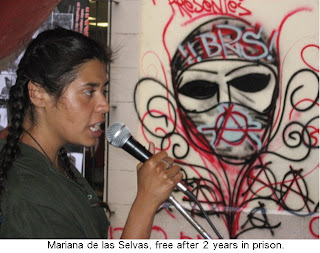
To say that political prisoners are always a part of the struggle means that we can't stop struggling until they are free. If the government knows that activists will stage an annual protest or only protest outside court hearings, then it knows it can wait us out, and our prisoners will never be free. Mariana de las Selvas Gomez, a political prisoner of the Atenco uprising, emphasizes that it was through the endless efforts of activists on the outside that she was finally freed after two years of imprisonment. “Despite the disappearances, the assassinations, the arrests...the struggle continued. The daily plantón and the protests to free the remaining sixteen Atenco political prisoners will continue as long as they're imprisoned.” And the Mexican government knows this.

Organizing within social justice movements for political prisoners' freedom goes beyond liberating prisoners and making movements whole again. It also presents an opportunity to radicalize and mobilize more legally compliant parts of the movement who still believe that justice is possible within the law. As Dan Berger points out in “Building a Political Prisoner Support Movement” in the June 2006 Left Turn, “Working to free political prisoners goes hand in hand with exposing the façade that the US is a country where injustice is minimal and solved through electoral politics: one point necessitates the other.” For this reason, we must work to free all political prisoners in the US: not just anarchist prisoners, not just people imprisoned against their will, but also people who having knowingly handed themselves over to the police or military in acts of civil disobedience and fully comply with the US legal system, such as SOA Watch or Catholic Worker activists. It presents an opportunity to demonstrate that the law won't liberate us; it will just repress us and our movements, so we must find another way to achieve our political goals and freedom for our political prisoners.

To fight the law and win without being constricted by the law, we must assure that no one, not activists, not the public, and certainly not the government, forgets that political prisoners exist and languish in our country's prisons. We have an unlimited supply of tactics at our disposal: dances, concerts, marches, movie screenings, protests, encampments, rallies, denouncements, declarations, forums, conferences, book discussions, graffiti, art and photography exhibitions, visits to political prisoners, street blockades... the possibilities are endless. Political prisoners of the Atenco uprising, for example, recently made prominent headlines in Mexico's nationally distributed newspaper La Jornada through the largest music festival ever held in San Salvador Atenco. Thousands of young people turned out for a ska concert with nationally-known bands like Antidoping to demand the release of Atenco's political prisoners.

Luckily, US activists don't have to start from scratch in the struggle to free our political prisoners. Pedro Rivera notes, “We've seen that there are already actions for political prisoners in your country, both for your political prisoners and for ours. These actions just need to be more formalized” and part of a long-term struggle to realistically demand the impossible: immediate and unconditional freedom for all of our political prisoners.

Read More!

Monday, April 07, 2008

The International Campaign Begins!


Movement for Justice in El Barrio launched their International Campaign in Defense of El Barrio from the steps of NY City Hall yesterday. Follow this link for pictures from the launch.

Also this past weekend, three members of El Kilombo Intergaláctico came through NYC on their book tour discussing the themes touched upon in their self-published "Beyond Resistance: Everything!", as well as the pamphlet Feliz Año Cabrones. These are perhaps the two best documents discussing the Zapatistas, the Other Campaign and their relevance to us in the USA to have been written in recent history... check them out!

UPDATE Apr 14 '08 - MJB reports on the International Campaign launch and announces the schedule of their European tour...

Movement for Justice in El Barrio Launches International Campaign in Defense of El Barrio:

On Sunday April 6th, Movement for Justice in El Barrio took the struggle against gentrification in NYC to an international level. Through the new International Campaign in Defense of El Barrio, Movement for Justice in El Barrio is organizing on a transnational level to combat displacement in El Barrio (East Harlem) by building a multi-national network to go after one of their main targets, the multi-national corporation Dawnay, Day Group at their central headquarters in London and on multiple continents where they hold property. Movement for Justice in El Barrio and their supporters from around the city and nation gathered on the steps of city hall to launch their “International Campaign in Defense of El Barrio.” With speeches, banners, signs and chants declaring “We will not be moved!” and “El Barrio no se vende/El Barrio will not be sold” East Harlem tenants of Dawnay, Day and members of Movement for Justice in El Barrio delivered the message that they will not allow these international profiteers to operate with impunity from across the ocean and showed them that people power can be transnational as well.

Members of Movement for Justice in El Barrio demanded that slumlords and multi-national corporations ceasetheir attacks on the community and denounced the City Council and the Department of Housing Preservation and Development for facilitating the displacement of low-income immigrants and people of color from their neighborhood.

The International Campaign in Defense of El Barrio will launch into action with a European tour to garner support and organize international action against new international threats. The tour will cover 15 cities in five different countries including England, Spain, France, Scotland and Wales.

In March a delegation from Movement for Justice in El Barrio began a national tour that has included stops in California, Texas, Connecticut, Pennsylvania, and Massachusetts, in order to construct a national network of supporters for their work organizing against gentrification here in El Barrio.

When the multi-national, multi-billion dollar London-based corporation Dawnay, Day Group purchased 47 buildings in El Barrio, they announced in an interview with the Times of London their plan to take advantage of lax tenant protection laws in NYC to raise rents by tenfold, a massive rent hike that would only be possible by evicting the current low-income and immigrant families from their homes.

Dawnay, Day is not your everyday slumlord. With properties all over the world and a base overseas, the fight against Dawnay Day must be local and international at the same time, and to this end, Movement for Justice in El Barrio has developed a multi-pronged approach to fighting back. On the local front, Movement for Justice in El Barrio has:

* Launched a new and groundbreaking legal suit that is challenging Dawnay, Day Group for charging thousands of dollars in false fees to its tenants

* Held a huge and historic march against gentrification in El Barrio at the end of August

* Fought back building by building to demand decent living conditions and halt illegal evictions

Now, through the new “International Campaign in Defense of El Barrio” Movement for Justice in El Barrio is expanding the struggle to hit Dawnay, Day on their home turf.

April

ENGLAND
18th-21st
Manchester

United Kingdom Solidarity Gathering

SPAIN
22nd-31st
Barcelona

Forums and events:
Recursos d’Animació Intercultural

Centro Social del Centro
Can Vies

26th-KRAX Conference with Participation from 11 countries including India, Chile,
Slovenia, Turkey and Finland.

29th-Collective in Solidarity with the Zapatista Rebellion

FRANCE
May 1st: Invited to Speak and participate in May Day March in Paris

May 2nd-6th
Cities: Paris and Aulnay sous bois

Forums and Events: National Confederation on Work, Encuentro with the homeless, Encuentro with immigrants, Committee in Solidarity with the Indigenous Peoples in Struggle in Chiapas, Committee in Solidarity with the Indigenous Peoples of America.

May

ENGLAND

Cities: Sheffield, Manchester, Liverpool, Bristol, Brighton

WALES

Cities: Cardiff

SCOTLAND

Cities: Aberdeen, Glasgow, Edinburgh

ENGLAND

Cities: Reading, London

May 25th: Return to El Barrio

Read More!

Monday, March 31, 2008

American Dream or Revolution?

George Carlin dropping some knowledge...

George Carlin and Grace Lee Boggs have been coming up again and again recently. First found this video above at De Tod@s Para Tod@s and then went to an Earthdriver show just days later to find DJ Oja was scratching up the audio to great effect. It was a real pleasure to be in Grace Lee Bogg's presence during the Left Forum... my favorite memory with her was from her "toast" at the Brecht Forum party where she asked the crowd, "How many people are over ninety?!" That's the most baller sh*t I've seen in a while...

Speaking of Boggs, check out how this year's Allied Media Conference in Detroit is shaping up. More locally, we've got Slingshot Hip Hop's NYC premiere this weekend (check out Harry Allen -of Public Enemy fame- plugging Slingshot here). At the Brecht Forum there's a transformative MLK, Jr & Memphis film/discussion on Wednesday night, and El Kilombo Intergaláctico doing their thing on Friday night. And as if that were'nt enough, don't forget to come out to NY City Hall on Sunday at 12:30p to support Movement for Justice in El Barrio as they launch their International Campaign in Defense of El Barrio!

In this way, somewhere between Carlin's bitter humor and Boggs' visionary leadership, we might just find...

The Next American Revolution
Despite the huge differences in local conditions, our Detroit-City of Hope campaign has more in common with the struggles of the Zapatistas in Chiapas than with the 1917 Russian Revolution because it involves a paradigm shift in the concept of revolution.
By Grace Lee Boggs
Left Forum Closing Plenary, Cooper Union, New York
March 16, 2008

I have decided to talk about the next American Revolution because I believe it is not only the key to global survival but also the most important step we can take in this period to build a new, more human and more socially and ecologically responsible nation that all of us, in every walk of life, whatever our race, ethnicity, gender, faith or national origin, will be proud to call our own.

I also feel that it would be a shame if we left this historic gathering in this Great Hall, at this pivotal time in our country’s history – when the power structure is obviously unable to resolve the twin crises of global wars and global warming, when millions are losing their jobs and homes, when Obama’s call for change is energizing so many young people and independents, and when white workers in Ohio, Michigan and Pennsylvania are reacting like victims — without discussing the next American revolution.

Since it is hard to struggle for something which you haven’t struggled to define and name, my aim this evening, quite frankly, is to initiate impassioned discussions about the next American revolution everywhere, in groups, small and large.

****
I begin with some history. Forty years ago my late husband, Jimmy Boggs, and I started Conversations in Maine with our old friends and comrades, Freddy and Lyman Paine, to explore how a revolution in our time in our country would differ from the many revolutions that took place around the world in the early and mid-20th century.

We four had been members of the Johnson-Forest Tendency, a tiny group inside the Workers Party and the Socialist Workers Party, led by C.L.R. James and Raya Dunayevskaya. Lyman, an architect, and Freddy, a worker and organizer, had been in the radical movement since the 1930s. Jimmy, an African American born and raised in the deep agricultural South, had worked on the line at Chrysler for 28 years and was a labor and community activist and writer. I was an Asian American intellectual who had been inspired by the 1941 March on Washington movement to become a movement activist, and after spending ten years in New York studying Marx and Lenin with CLR and Raya, had moved to Detroit in 1953, married Jimmy Boggs and became involved in the struggles organically developing in the Detroit community.

Our mantra in the Johnson-Forest Tendency had been the famous paragraph in Capital where Marx celebrates “the revolt of the working class always increasing in numbers and united, organized and disciplined by the very mechanism of the process of capitalist production.” In the early 60s when the working class was decreasing rather than increasing under the impact of what we then called “automation,” we separated from CLR when he opposed our decision to rethink Marxism.

Our separation freed us to recognize unequivocally that we were coming to the end of the relatively short industrial epoch on which Marx’s epic analysis had been based. We could see clearly that the United States was in the process of transitioning to a new mode of production, based on new informational technologies, and that this transitioning was not only epoch-ending but epoch-opening, with cultural and political ramifications as far-reaching as those involved in the transition from Hunting and Gathering to Agriculture or from Agriculture to Industry.

As movement activists and theoreticians in the tumultuous year of 1968, we were also acutely conscious that in the wake of the civil rights movement, beginning with the Montgomery bus boycott in 1955, Rachel Carson’s Silent Spring in 1962, and the exploding anti-Vietnam war and women’s movements, new and more profound questions of our relationships with one another, with Nature, and with other countries were being raised with a centrality unthinkable in earlier revolutions.

Hence, as our conversations continued, we became increasingly convinced that our revolution in our country in the late 20th century had to be radically different from the revolutions that had taken place in pre-or-non-industrialized countries like Russia, Cuba, China or Vietnam. Those revolutions had been made not only to correct injustices but to achieve rapid economic growth. By contrast, as citizens of a nation which had achieved its rapid economic growth and prosperity at the expense of African Americans, Native Americans, other people of color, and peoples all over the world, our priority had to be correcting the injustices and backwardness of our relationships with one another, with other countries and with the Earth.

In other words, our revolution had to be for the purpose of accelerating our evolution to a higher plateau of humanity. That’s why we called our philosophy “Dialectical Humanism” as contrasted with the “Dialectical Materialism” of Marxism.

Six years later the practical implications of this somewhat abstract concept of an American revolution were spelled out by Jimmy in the chapter entitled “ Dialectics and Revolution” in Revolution and Evolution in the 20th Century (Monthly Review Press, 1974).

“The revolution to be made in the United States,” Jimmy wrote, nearly 30 years before 9/11, “will be the first revolution in history to require the masses to make material sacrifices rather than to acquire more material things. We must give up many of the things which this country has enjoyed at the expense of damning over one third of the world into a state of underdevelopment, ignorance, disease and early death.” Until that takes place, “this country will not be safe for the world and revolutionary warfare on an international scale against the United States will remain the wave of the present.”

“It is obviously going to take a tremendous transformation to prepare the people of the United States for these new social goals.” Jimmy continued. “But potential revolutionaries can only become true revolutionaries if they take the side of those who believe that humanity can be transformed.” Thus, the American revolution, at this stage in our history and in the evolution of technology and of the human race, is not about Jobs or health insurance or making it possible for more people to realize the American Dream of upward mobility. It is about acknowledging that we Americans enjoy middle class comforts at the expense of other peoples all over the world. It is about living the kind of lives that will end the galloping inequality both inside this country and between the Global North and the Global South, and also slow down global warming. It is about creating a new American Dream whose goal is a higher humanity instead of the higher standard of living which is dependent upon Empire. About practicing a new more active, global and participatory concept of citizenship. About becoming the change we want to see in the world.

The courage, commitment and strategies required for this kind of revolution are very different from those required to storm the Kremlin or the White House. Instead of viewing the American people as masses to be mobilized in increasingly aggressive struggles for higher wages, better jobs or guaranteed health care, we must have the courage to challenge them and ourselves to engage in activities that build a new and better world by improving the physical, psychological, political and spiritual health of ourselves, our families, our communities, our cities, our world and our planet.

This means that it is not enough to organize mobilizations calling on Congress and the President to end the war in Iraq. We must also challenge the American people to examine why 9/11 happened and why so many people around the world who, while not supporting the terrorists, understand that they were driven to these acts by anger at the U.S. role in the world, e.g. supporting the Israeli occupation of Palestine, overthrowing or seeking to overthrow democratically-elected governments, and treating whole countries, the world’s peoples and Nature only as a resource enabling us to maintain our middle class way of life.

We have to help the American people find the moral strength to recognize that, although no amount of money can compensate for the countless deaths and indescribable suffering that our criminal invasion and occupation have caused the Iraqi people, we, the American people, have a responsibility to make the material sacrifices that will help them rebuild their infrastructure. We have to help the American people grow their souls (which is not a noun but a verb) enough to recognize that since we, who are only 4% of the world’s population, have been consuming 25% of the planet’s resources, we are the ones who must take the first big steps to reduce greenhouse emissions. We are the ones who must live more simply so that others can simply live.

Moreover, we need to begin creating ways to live more frugally and cooperatively NOW because as times get harder, we “good Americans,” if we view ourselves only as victims, can easily slip into scapegoating the “other” and goose-stepping behind a nationalist leader, as the “good Germans” did in the 1930s, with Hitler.

This vision of an American revolution as transformation is the one projected by Dr. Martin Luther King Jr. in his April 4, 1967 anti-Vietnam war speech. As Vincent Harding, Martin’s close friend and colleague, put it recently on Democracy Now, King was calling on us to redeem the soul of America. Speaking for the weak, the poor, the despairing and the alienated, in our inner cities and in the rice paddies of Vietnam, he was urging us to become a more mature people by making a radical revolution not only against racism but against materialism and militarism. He was challenging us to “rededicate ourselves to the long and bitter, but beautiful, struggle for a new world.”

King was assassinated before he could devise concrete ways to move us towards this radical revolution of values. But why haven’t we who think of ourselves as American radicals picked up the torch? Is it because a radical revolution of values against racism, militarism and materialism is beyond our imaginations, even though we are citizens of a nation with 700 military bases whose unbridled consumerism imperil the planet?

***
In Detroit we are engaged in this “long and beautiful struggle for a new world,” not because of King’s influence (we identified more with Malcolm) but because we have learned through our own experience that just changing the color of those in political power was not enough to stem the devastation of our city resulting from deindustrialization.

I don’t have time this evening to tell you the story of our Detroit-City of Hope campaign. We hosted a panel about it yesterday morning and you can read about it in the Boggs Center broadsheet.

Our campaign involves rebuilding, redefining and respiriting Detroit from the ground up: growing food on abandoned lots, reinventing education to include children in community-building, creating co-operatives to produce local goods for local needs, developing Peace Zones to transform our relationships with one another in our homes and on our streets, replacing punitive justice with Restorative Justice programs to keep non-violent offenders in our communities and out of prisons that not only misspend billions much needed for roads and schools but turn minor offenders into hardened criminals.

It is a multigenerational campaign, involving the very old as well as the very young, and all the inbetweens, especially the Millennial generation, born in the late 1970s and 1980s, whose aptitude with the new communications technology empowers them to be remarkably self-inventive and multi-tasking and to connect and reconnect 24/7 with individuals near and far.

Despite the huge differences in local conditions, our Detroit-City of Hope campaign has more in common with the struggles of the Zapatistas in Chiapas than with the 1917 Russian Revolution because it involves a paradigm shift in the concept of revolution.

One way to understand the paradigm shift is by contrasting our vision of health in a revolutionary America with the health care programs offered by the Democratic presidential front-runners.

Hillary’s and Obama’s “health care” programs are really insurance programs having more to do with feeding the already monstrous medical-industrial complex than with our physical, mental and spiritual health. By contrast, once we understand that our schools are in such crisis because they were created a hundred years ago in the industrial epoch to prepare children to become cogs in the economic machine; once we recognize that our challenge in the 21st century is to engage our children from K-12 in problem-solving and community-building activities, our children and young people will become participants in caring for their own health and that of our families and communities. Eating food they’ve grown for themselves, creating and sharing information from the Net, and organizing health festivals for the community, they will not only be caring for their own health. They will be helping to heal our communities.

This kind of transformation is what the next American revolution is about. It is not a single event but a process. It involves all of us, from many different walks of life, ethnicities, national origins, sexual orientations, faiths. At the same time, based on our experiences in Detroit and the panels I attended at this weekend’s Forum, I see the Millennial generation playing a pivotal role. As Frantz Fanon put it in The Wretched of the Earth, “Each generation, coming out of obscurity, must define its mission and fulfill or betray it.”

Read More!

Monday, March 24, 2008

Fighting Free Trade Agreements


Reminder for those in NYC, come to the Judson Memorial Church on Wednesday at 7p for what is sure to be an incredible event with Movement for Justice in El Barrio and Gloria Muñoz Ramírez.


With their January 1st, 1994 uprising -on the same day that the North American Free Trade Agreement (NAFTA) went into effect- the Zapatistas helped to kick-off the ongoing global cycle of struggle against free trade agreements (referred to as "FTAs") and supranational organizations such as the World Trade Organization (WTO), International Monetary Fund (IMF), and the World Bank.

With the WTO, IMF, World Bank and regional free trade agreements such as the Free Trade Area of the Americas (FTAA) greatly weakened or non-functional thanks to global resistance, neoliberal capitalists have shifted their focus to securing bi-lateral free trade agreements. These agreements are being strongly resisted in many places around the world and now there is a print and web-based project, Fighting FTAs, that is helping to gather, create, circulate, and organize the knowledge needed to defeat these destructive projects... check it out, use it, pass it on.

Read More!

Monday, March 17, 2008

Spring in NYC

Autumn "Rock Dove" Brown, Ai-Jen "DWU" Poo, RJ "Regeneración" Maccani, Max "War Times" Elbaum, and Max "Left Turn" Uhlenbeck at 1968 Revisited: Prospects for a More Coherent Left (photo by Dhyta)

More than just the weather is heating up here but, before getting to all this NYC zapatismo activity, I can't recommend strongly enough "Warning the World that Zapatismo is in Danger" by Jorge Alonso. OK, where were we?

The Left Forum was pretty dang PACKED this year... and so was the Brecht Forum on Saturday night where the youth and the elders (Tariq Ali, Grace Lee Boggs, Ashanti Alston, and Max Elbaum amongst them) joined together in an historic force to "Party Like It's 1968!" Now let's see if some of that spirit will spill into the streets this week marking the 5th Anniversary of the US-led Invasion of Iraq...

Leading up to all the Left/Brecht Forum madness over the weekend was another packed event at the Brecht called "Prospects for a More Coherent Left: An Intergenerational Dialogue from the Grassroots" featuring a discussion between Max Elbaum, Ai-Jen Poo, Autumn Brown and I - you can find the audio here. Now here's a sampling of...


'Zapatismo in NYC' events this Spring


MARCH 26 (Wednesday): Gloria Muñoz Ramírez bringing the Fire and the Word to Judson Memorial Church in support of Movement for Justice in El Barrio's premiere of their film from the NYC Encuentro for Dignity and Against Gentrification - full details here.

APRIL 4 (Friday): El Kilombo Intergaláctico at the Brecht Forum: "Beyond Resistance: Everything! The Zapatistas, the Other Campaign & US" - full details here.

APRIL 6 (Sunday): Join Movement for Justice in El Barrio at 12:30p on the steps of New York City Hall to launch the International Campaign in Defense of El Barrio! - call out here.

JUNE 4, 11, 18 & 25 (Wednesdays): Join yours truly at the Brecht Forum for a four-session interactive class called, of course, "Enter the Intergalactic! Zapatismo in the US & the World." Details here.

Read More!

Monday, March 10, 2008

CIW/SFA in Solidarity


Israeli Apartheid Week NYC closing panel featuring members of the Coalition of Immokalee Workers (CIW) and the Student/Farmworker Alliance (SFA)

If you are in NYC this week, please come check out "Prospects for a More Coherent Left: An Intergenerational Movement Discussion from the Grassroots!" at the Brecht Forum on Thursday night...

The Coalition of Immokalee Workers (CIW), a 2,500 member community-based worker organization of Latino, Haitian, and Mayan Indian immigrants working in low-wage jobs throughout the state of Florida, continues to be an inspirational example of successful struggle and solidarity within the US Left. A little over a year ago, on the eve of their victory over McDonald's, I posted a translation of their adherence speech to the Zapatistas' Sixth Declaration of the Lacandon Jungle.

Last month, CIW member Romeo Ramirez and Student/Farmworker Alliance (SFA) member Melody Gonzalez traveled all the way from Immokalee, Florida to New York City to show their solidarity with the Palestinian freedom struggle by participating in NYC's Israeli Apartheid Week activities. Check out the above video of that week's incredible closing panel featuring Romeo and Melody of the CIW/SFA as well as representatives from the Canadian Union of Public Employees and the Congress of South African Trade Unions. It is powerful to say the least.

And now this month, the SFA has endorsed the principles of Movement for Justice in El Barrio's International Declaration in Defense of El Barrio and are joining their network of supporters... So, in the spirit of solidarity, please take a moment to sign and circulate the CIW's National Petition to End Sweatshops and Slavery in the Fields!

Read More!