Thursday, October 25, 2007

Zapatismo in Spanish Harlem


Zapatismo in Spanish Harlem

The Movement for Justice in El Barrio, Inspired by the Zapatista Other Campaign, Brings New Yorkers Together to Fight Gentrification
By RJ Maccani
Originally appears at The Narco News Bulletin
en español aqui
Find their reportback on the encuentro here

An echo that turns itself into many voices, into a network of voices that, before the deafness of the Power, opts to speak to itself, knowing itself to be one and many, acknowledging itself to be equal in its desire to listen and be listened to, recognizing itself as different in the tonalities and levels of voices forming it. A network of voices that resist the war that the Power wages on them.
- excerpt from the Zapatistas' Second Declaration of La Realidad
Over thirteen years since their famed uprising in the southeastern Mexican state of Chiapas, the Zapatistas’ words continue to reverberate throughout the world. Last Sunday, October 21, they echoed from East Harlem and throughout New York City at the first ever “NYC Encuentro for Humanity and Against Gentrification.”

Billed by hosts Movement for Justice in El Barrio (MJB) as “…a way of sharing developed by the Zapatistas as another form of doing politics: from below and to the left,” at least 15 different organizations working against gentrification from throughout the city in addition to observers from groups based in Rhode Island, Connecticut, New Jersey and Pennsylvania came to MJB’s East Harlem seeking to create “…a place where we can all speak, we will all listen, and we can all learn.”

The result was a multi-lingual and multi-media evening of sharing hope and resistance in the struggle against gentrification. A key element of the encuentro was a fish-bowl style innovation on the typical panel presentation wherein five of the participating organizations rotated in responding to various themes while the other hundred or so in attendance listened. Similar in style to gatherings of the Other Campaign, MJB laid out the four stage flow of the discussion passing from “Who we are” to “Conditions we face and root causes” to “Our forms of struggle” and concluding with “Sharing our dreams.”

Many Struggles (and Some Common Enemies)

“We are fighting the landlords and a government who have no heart,” began Bin Liang, an elder member of CAAAV Organizing Asian Communities, which has been organizing "across diverse, low-wage, and poor Asian communities in New York City for over 20 years." With translation from CAAAV’s Chinatown Justice Project organizer, Helena Wong, Liang went on to describe how landlords will leave them without heat or hot water during the winter in apartments where ceilings collapse. In one case, a hole was left in the ceiling such that “the people living in the fourth floor apartment could watch us using the bathroom in our third floor apartment.”

Desiree, Jay, and X from FIERCE!, a community organization for Queer youth of color in New York City, followed with a look at their continued struggle over Pier 45, commonly known as the Christopher Street Pier, on the coast of Manhattan’s Far West Village. A decades-long common gathering point for queer youth of color from throughout the city and beyond, the Hudson River Piers have increasingly become sites of police harassment for FIERCE!’s members as “revitilization plans” are pursued by the city and private developers.

The next two participating groups were The Union of New York Tenants (UNYTE), a city-wide tenants empowerment group, and the SRO Law Project, which provides free legal services and organizing assistance to some of the most vulnerable tenants in the city. “SRO” refers to the single room occupancy buildings that house tenants who usually earn less than $10,000 a year, paying over half of that in rent and sharing a bathroom and kitchen with other residents. Matt Wade, an organizer with the SRO Law Project, reported that over four-fifths, or 100,000 units, of SRO housing in the city has been lost in the last decade to real estate developers who have been aided by the city’s politicians.

Indeed, every participant in the dialogue spoke to the problem of collusion between the city’s politicians and capitalist developers. The Department of Housing Preservation and Development (HPD) was a common site of struggle. Concluding each go around with a different member, MJB’s Oscar Dominguez spoke to the way that “HPD plays favorites with the rich landlords, the city allows them to come into El Barrio to establish luxury restaurants and stores while kicking out the street vendors and community-run stores.”

Strategic Convergence

As the dialogue continued, the places where struggles overlapped and could complement each other began to come into view. Rob Hollander, an organizer with UNYTE who lives on the Lower East Side, signaled that luxury hotel development on the Bowery, one of Manhattan’s last true north/south running streets, will spell doom for the immigrant communities of his neighborhood as well as for those of Little Italy and Chinatown: “Immigrants are being pushed out by people with money and it is changing the color of our neighborhoods. It is changing what is beautiful about New York.” CAAAV’s Bin Liang followed up on this to point out that her landlord had a hand in gentrifying Harlem before moving on to Chinatown.

After announcing many of their recent victories in the struggle over Pier 45, FIERCE! named Pier 40 as another site of struggle now that a $700 million development plan dubbed “Vegas on the Hudson” is underway. The Hudson River Park Trust is currently in the process of reviewing proposals to create what will likely be a massive, Vegas-style complex, not only erasing some of the last open space in the city but also radically altering much of the surrounding neighborhood. As with the development at Pier 45 and wherever gentrification takes place, the FIERCE! youth are anticipating greater harassment of queer youth of color as police seek to appease the area’s increasingly wealthy clientele. In a move that could benefit those in struggle throughout the city, FIERCE! announced their participation in the launch of a city-wide Cop Watch movement as part of the People's Justice Coalition.

From tenant associations and rent strikes to press conferences and lawsuits, the groups struggling against gentrification in New York City not only share common enemies, but also a wide range of common tactics. One aspect that stood out was MJB’s approach, similar to that of the rest of their compañeros in the Other Campaign, to democracy and politicians: “We represent ourselves,” remarked MJB member Victor Caletre, “each of the 23 buildings we work in has its own tenant association that decides what they will do and how they will choose to struggle. And the rest of the organization supports their decision…It’s not only an organization that is struggling, but a community, and that community has the right to decide.” With this in mind, MJB recently carried out a Consulta del Barrio in which they consulted residents in East Harlem in order “to hear from people about where we should direct our next struggle.”

MJB has undertaken this community consultation while at the same time deligitimizing their City Council Representative, Melissa Mark-Viverito. Caletre announced at the Encuentro that not only did Mark-Viverito give herself a raise (increasing her salary to $112,000 a year while representing a neighborhood where nearly 40% of its residents live below the poverty line), but she has also attempted to buy him off. Apparently two young men visited him at his apartment recently to offer him a position with the city, under the condition that he stop working with MJB!

A First Step

Through employing many different forms of presentation, and patient translation, the Encuentro succeeded in working across barriers of language (Spanish, English, and Chinese), culture, and age. The fish-bowl style dialogue portion of the Encuentro concluded with a rousing gentrification-themed play and series of group songs led by Brooklyn-based members of Make the Road New York. This was followed by two videos, one from CAAAV depicting a moment in their victorious campaign against a landlord on Delancey Street and one by MJB from their first “Mega-March” to confront East Harlem’s three worst landlords, as well as HPD and, of course, Councilmember Mark-Viverito.

The presentations concluded just as they had opened, with a video of the Zapatistas. The gathering opened with footage of EZLN Major Ana Laura speaking at the First Intercontinental Gathering for Humanity and Against Neoliberalism and it closed with the Zapatistas retaking their land from the Mexican military. The entire event closed with a horde of kids taking their turns hitting the neoliberal gentrification piñata.

The NYC Encuentro for Dignity and Against Gentrification was a new first step in bringing together struggles against gentrification. As MJB’s Oscar Dominguez pointed out, “It is not just the landlords that we are against, but the interests behind the landlords. Our common enemy is neoliberalism.” Helena Wong, of CAAAV, shared this sentiment, remarking, “The connections are close. The money driving gentrification in the USA is coming from all over the world.” It is no surprise then that the Encuentro received support from the Right to the City Alliance, composed of groups struggling against gentrification all over the U.S., and the International Alliance of Inhabitants, a world-wide network seeking to make connections across borders for adequate housing and livable cities.

MJB is already following up on the gathering. They held an evaluation meeting with their membership on Tuesday and will soon be seeking feedback from all attending organizations. If the early reports are any sign, there will be much enthusiasm for future collaboration. Checking in with members of CAAAV after the Encuentro, Liang remarked to me, “I’m really happy that we were able to come together and are all enthusiastic about fighting capitalism.”

Read More!

Thursday, October 18, 2007

The Vícam Declaration


Reports from the Encuentro of the Indigenous People of América are still coming in. I was hoping to share with you an English version of the Encuentro's "Vícam Declaration," but I've not yet found it available in print...and the task of translating from the audio recording seemed too daunting. So here in its place is a solid piece by Hermann Bellinghausen:

Rebel Imports' Kristin Bricker has translated the Vicam Declaration! You can read it here.

The Vícam Declaration:
“we will defend mother earth with our lives”
by Hermann Bellinghausen
Originally published in La Jornada
Translation by Zapagringo

Vícam, Sonora, October 14. The rebellion that will shake the continent will not repeat the paths and ways of others that have changed the course of history, subcomandante Marcos proclaims tonight in the closing ceremony of the Encuentro of the Indigenous Peoples of América. “When the wind that we are dies down," he adds, “a new time will open in which we will be all of the colors."

After greeting in the languages of Yoeme, Castilian [“Spanish”], and English, and taking words from the Yaqui tradition, Marcos declares before the audience, which has doubled itself on this night in Vícam: “The four wheels of the vehicle of money are rolling again over the path of the blood and the pain of the peoples of the continent," in what he calls “the largest war in the history of humanity, which is already 515 years old." The war that they commemorate every October 12.

This war now reproduces “the age and methods of the great trusts and estates, of the epoch in which the crowns of Europe dominated through blood and fire." Referring to the repression that armies and paramilitary forces use, “just as in the times of the Conquest," in order to eliminate entire populations.

"Nevertheless, something has changed: there has never been so much destruction and stupidity by the governments, such brutality against the earth and people." Because, indicates the Zapatista delegate, "it happens that they are killing the world." They say that it is "electoral democracy" that thing with which the “bossy people” make the “business” of bringing the world to catastrophe. There above “there is no hope for the Indian peoples."

In this encuentro, “memory has been the invisible thread that unites our peoples," explains Marcos, and concentrates the cause of their struggles into just one word, which comes from the birth of humanity: “freedom”. It is what the people want, he continues, "and it cannot exist without justice or democracy." It trusts that there will be "a world without rulers," something that "seems impossible" today.

They denounce the growing plunder of the land

In turn, the Rarámuri Francisco Palmo reads the final declaration of the Encuentro of the Indigenous Peoples of América. It is directed against the arrogance of power, because the plundering of the land and resources of the people “grows with each passing day." But, it adds, “the resistance and indignation of the people grows as well."

The 570 delegates from 67 indigenous peoples, coming from 12 american nations, affirmed, in the Declaration of Vicam: “We are descendents of the peoples, nations and tribes that first gave name to these lands; that were born of mother earth and maintain a sacred respect towards her that provides us with life and keeps us in death; thus we declare to the entire world that we will care for and defend mother earth with our lives." They tell of the “pain suffered from the attack of the invaders, supported in the false arguments of cultural exclusivity and arrogant civilizing presumptions, with the purpose of plundering our territories, destroying our cultures and disappearing our peoples."

The participants in the encuentro proclaimed their historic right to free self-determination, “respecting the different ways that, for the exercise of this, our people decide, according to their origin, history and aspirations." Also, they reject “the war of conquest and capitalist extermination imposed by the transnational companies and the international financial organizations in complicity with the great powers and nation states."

They express their rejection of “the destruction and sacking of mother earth by means of the occupation of our territories for industrial, mining, agribusiness, touristic, savage urbanization and infrastructure activities, as well as the privatization of the water, land, forests, oceans and coasts, biological diversity, the air, the rain, traditional knowledge and all that is born of mother earth."

They oppose “the registration of the land, coasts, waters, seeds, plants, animals and traditional knowledges of our peoples with the aim of privatizing them," and they reject the occupation and destruction of sacred centers and places, as well as the mercantilization of their culture. They also reject the Escalera Náutica or Sea of Cortés megaproject and the construction of the coastal highway inside of Yaqui territory.

The encuentro ratifies its rejection of the 2010 Winter Olympics “in Vancouver, Canada on sacred territory, stolen from the Turtle nation with the goal of installing ski runs."

They denounce that the war of conquest and capitalist extermination “worsens like never before the exploitation of the members of our peoples on plantations and in sweatshops, or as migrants in cities and distant countries, where they are hired in the worst conditions, finding themselves in situations of slavery and forced labor."

The rejections extend to the big transnational stores, “that plunder the economic resources of the communities," and to neoliberal policies, which debilitate communitarian economies and food sovereignty and result in the loss of native seeds. They commit to seek the integral reconstitution of their peoples and to strengthen their cultures, languages, traditions, organization and self-government.

“Supported in our culture and vision of the world, we will reinforce and recreate our own educative institutions, rejecting the educative models that the nation states impose on us to exterminate our cultures.”

They pronounce against “all form of repression towards our peoples, expressed in the militarization and paramilitarization of our territories, forced displacement, mass deportation, the imposition of borders in order to divide and fragment, and the imprisonment and disappearance of those who struggle for the historic revindication of our peoples”.

The absent indigenous “political prisoners” are a strong “presence”. Some sent greetings from El Amate (Chiapas) and Molino de Flores (Texcoco, in particular the Mazahua Magdalena García Durán). “They were” the Oaxacans of Loxicha, San Isidro Aloapam, the organization VOCAL and other members of the Popular Assembly of the Peoples of Oaxaca; also the Zapatista prisoners in Tabasco, as well as the Lakota leader Leonard Peltier. They demanded immediate freedom for all.

The Yaqui of Vicam and from other towns came in great numbers to the closing, in which the traditional dances of the Deer and the Pascola were offered. Thus, nearly 3 thousand people participated in the culminating moment of the encuentro.
Read More!

Thursday, October 11, 2007

The Other NY Denounces Repression Against Zaps

Movement for Justice in El Barrio Rallying Against Gentrification in East Harlem

The Indigenous Encuentro of the Americas begins today in Sonora, Mexico amidst a campaign of corporate media disinformation, state harassment of caravans traveling across Mexico to attend the Encuentro, and the denial of visas to some international participants. Meanwhile the Zapatista communities continue to denounce mounting repression against them in Chiapas. As a result, almost the entire Sixth Commission of the Zapatista Army of National Liberation has remained in their communities sending Subcomandante Insurgente Marcos as their sole representative to the Encuentro. Here in New York City, as Other Campaign adherents Movement for Justice in El Barrio are finishing preparations for the NYC Encuentro for Dignity and Against Gentrification, they are also preparing to mobilize as needed to help halt this repression against the Zapatistas:


en español aqui

To Our Zapatista Sisters and Brothers:

To All Organizations, Groups, Collectives, Families, and Individuals in “The Other Campaign:”

To All Mexicans and Chicanos in The Other Campaign in the United States:

To All International Adherents to the Sixth Declaration:

We send a fraternal embrace to Mexico, from adherents of the Other Campaign here in New York, members of Movement for Justice in El Barrio. Compañeros and Compañeras, we send this urgent message so that you may know that here in New York we're all paying attention to the threats and to the hostile manner in which military officials have treated the Sixth Commission on their way to the Encuentro of the Indigenous Peoples of America in Vicam, Sonora and of the hostility and aggressive threats that they are confronting, first with the verbal hostility directed towards them during their participation in a round table discussion in the City of Mexico, and now of the confrontations with the military as they tried to detain them along their way. We want you to know that we are prepared to organize actions here in New York against the repression being carried out in Chiapas and against any repression that may arise during The Sixth Commission’s journey to the Encuentro of the Indigenous Peoples of America.

We seriously lament the interruption of the Second Stage of The Other Campaign due to the repressive actions carried out in Chiapas by the federal government, the PAN, and the state government, the PRD. Here in New York, in cities across the United States, and everywhere that we hold public forums, we have made sure to spread the word about The Other Campaign's Second Stage, and everywhere that it was announced, it was always received with much enthusiasm. We know that the Second Stage will continue, but for the time being, it will do so without the participation of the Zapatista delegation, which was cancelled due to the repressive actions in Chiapas.

According to the Center for Political Analysis and Social and Economic Research, there has not been such heavy military presence and brutal displacement since 9 years ago under the government of Zedillo, when Zedillo ordered the dismantling of autonomous Zapatista communities. Now under the federal government of Felipe Calderon and the state government of Juan Sabines, there are 79 permanent military camps, more than half of which, 56 of them, being directly on indigenous territory. Hundreds of families live under the threat of being displaced, while many have already been displaced and arrested under false pretenses. While numerous people have been arrested for supposed "ecocide" and families that are taken from their homes remain under police surveillance, under conditions that lack basic necessities and services: being fed only rice and not being allowed to use the restrooms for the simple reason of being indigenous. These actions are being conducted by both the federal government (PAN) institutions, such as the Federal Investigation Agency and the Attorney General of the Republic, as well as the state government (PRD) institutions, such as the State Investigation Agency, the District Attorney’s Office for the Jungle Region and the Secretary of the State.

We, adherents of The Other Campaign here in New York, are fighting in our own ways against a different kind of Neoliberal-driven displacement. We understand that these displacements may be different but have the same end results, and that our struggles also have the same goals. Because of this, we also understand that displacement imposes on us pretexts and crimes that we are not guilty of. Over there they call it "ecocide", over here they call it "being illegal". Both here and there they call us illegal. Here, because we are Mexican and poor, they try to throw us out of the apartments we rent, for the neoliberal remodeling of our communities; so they may build luxury condominiums, banks, hotels, and elegant offices. They use our cheap labor and yet they call us "illegal" for working. We know that over there, because you are indigenous and poor they are looking to push you out of your autonomous communities so that big business and transnational corporations can build hotels, tourist centers, banks, and luxurious buildings in what was once the jungle, the lands that you work, the land that belongs to those who work it, as Zapata use to say.

Because of this and much more we identify with your struggle and declare that we are against neoliberal displacement, here and over there. We want to tell you that we will not allow displacement either here or over there.

We also want to make a side note that this brutal neoliberal displacement that is being lived in New York, better known as gentrification, intensified under the administration of ex-Mayor Giuliani; who afterwards was contracted by ex-Mayor of Mexico City, Andres Manuel Lopez Obrador.

Along with our local struggles, we're organizing a contingency plan of action against the repression being implemented in Chiapas by the federal government, the PAN, and the state government, the PRD. We will continue to keep ourselves informed. We wish the delegates of the Sixth Commission a good journey, and we send our greetings along with a congratulation to the participants of the Encuentro of the Indigenous Peoples of America.

Zapata Lives! The Struggle Continues!

Democracy!

Liberty!

Justice!

An End to Neoliberal Displacement here and over there!

From the Other Campaign New York.
Movement for Justice in El Barrio
From the Other Side, October 2007.

Read More!

Thursday, October 04, 2007

Casa Atabex Aché : Womyn's Encuentro


UPDATES
12/31/07: Bilingual coverage of the Womyn's Encuentro at Indymedia Chiapas
12/23/07: Information, themes and schedule for the encuentro here


Womyn of color here in NYC are organizing to attend the Third Encuentro of the Zapatista Peoples with the Peoples of the World "Comandanta Ramona and the Women Zapatistas," also known as "
The Womyn's Encuentro". One of the groups leading the effort is Casa Atabex Aché. Below is a call out with dates for organizing here in NYC and, below that, an interview that Casa members conducted with Zapatistas this August, which they distributed as part of their participation in last week's "The Zapatistas and the World" event.

Also, the Center for Political Analysis and Social and Economic Investigations (CAPISE) has concluded that the Zapatistas are facing the worst government offensive in 9 years - read the English translation of their report for details and stay tuned here for updates and calls to action. And although the Zapatistas have canceled their upcoming Other Campaign tour of Central and Southern Mexico in order to organize peaceful actions in defense of their communities, they are sending delegates to the Yaqui town of Vicam, in Sonora, Mexico, to participate in the Indigenous Encuentro of the Americas. In fact, the first of four regional pre-meetings for the Encuentro begins in Oaxaca today to gather those delegates coming from indigenous groups in South and Southeast Mexico.

Casa Atabex Aché : Womyn's Encuentro

We are going to speak, us women Zapatistas, with compañeras from Mexico and the world and you will be able to ask questions of how we organize ourselves, the women Zapatistas, more directly with women. We are going to ask the compañeros men Zapatistas that they help us with logistical questions. Compañeros from Mexico and the world may also come to hear us, but remain silent, same as our compañeros men Zapatistas. -Compañera Everilda announcing the Womyn's Encuentro
Collaborate with Casa Atabex Aché, Coatlicue Theater Company, Estación Libre & womyn of color from NYC to organize a delegation to the Womyn’s Encuentro in Chiapas (Dec 28, 2007 – Jan 1, 2008):
  • October 9th: First delegation meeting 6-8pm bring fundraising ideas, questions and art/theme for delegation flyer. Come hear us speak about the summer in Chiapas. During the summer Casa Atabex Aché had the opportunity to organize a second delegation of women of color and attend the 2nd Encuentro. Below you will find our conversation with the community and the Clinica de Guadalupe as Casa embarks on a journey to create a sustainable autonomous healthcare cooperative in the South Bronx. The meeting will happen at Casa's space at 471 East 140th St.
  • November 2nd: Fundraiser from 8p to Midnight celebrating Dia de los Muertos with a performance by the Coatlicue Theater Company on the Zapatistas
For more information please call 718-585-5540.

Goals for the delegation:
  • Explore Womyn Zapatistas strategies of autonomy and self-determination.
  • Identify commonalities and differences in our practice of social transformation & spirituality.
  • Discuss demands that Zapatista womyn made which challenge patriarchy and violence against womyn within their movement.
  • Self-healing work in community: How do womyn of color heal from internalized oppression and strategize collectively to create the world we want to live in and make sure we are at the forefront of our movements?
Our sisters in Chiapas have put a call out to us to join them in this once in a lifetime event - A powerful day for womyn worldwide. Come dialogue and create an action plan for autonomy and liberation in NYC. The Zapatista womyn are celebrating themselves and womyn all over the world for saying “YA BASTA” and playing leading roles on all fronts in the struggle to build alternatives in the movement for social and economic justice.

During our delegation we will speak about Zapatista women's collective strategies of resistance, the creation of cooperatives (development of alternative economies), rotating leadership, collective community governance, community health clinics and community schools. In addition, we will discuss how communities of color can come together and use some of these principles to create autonomous communities in NYC, challenging the non-profit industrial complex & patriarchy, sexism within our movements. Promote a sustainable model of community organizing itself within a spiritual and political framework. Discuss the leadership of womyn & people of color in organizing and self-sustainability.

During the summer Casa had the opportunity to organize a second delegation of women of color and attend the 2nd Encuentro. Below you will find our conversation with the community and the Clinica de Guadalupe as Casa embarks on a journey to create a sustainable autonomous healthcare cooperative in the South Bronx.

Casa Atabex Aché - A Conversation with the Zapatistas
August 19th, 2007

ON HEALTH - Health is not only the services that hospitals and clinics give. It is also the nutrition of a community, the education of a community, the well being of a community and all of the needs of a community being met at the same time.

NUTRITION/ALIMENTACIÓN- People think that malnutrition comes from not having something to eat. But that is not it…. It is also about the quality and the conditions of the food not just about having or not having something to eat. We want the community to change consciousness from “ I am producing these foods to economically sustain myself and sell it” to “ I am producing this to eat and feed my family. It is not about what we think people should eat or us telling them--we want the community to get this themselves. We want community to look at the problem and then make their own decisions, their own change. Example: Look at capitalism and its effect. It’s not about you stopping the drinking of Coca-Cola its about you understanding the bigger impact that Coca-Cola has a cooperation and what it is doing to the people and the land, the role it plays in capitalism.

ON BUILDING ALTERNATIVE CLINICS - Indigenous communities don’t have access to services and hospitals. That is why we started our clinic. The Clinica de Guadalupe provides basic services, there is only one coordinator, 300 health promoters - they are still building strength, have many difficulties and necessities, and are still building the infrastructure of the clinic. The difference between their clinic and the government hospitals is that they give adequate healthcare while the government just gives a service. Adequate healthcare includes earning community trust and providing “JUST” service. That is why we are focusing on developing clinics for autonomy that the community has control over.

This clinic is many years in the making from communities that are in resistance. This is a war because we are looking for change - change not only overall but within the person, family and community, to sustain something bigger than us. Little by little (it’s big work) it’s years in the making. It’s about community participation in creating the world they want. Unity and consciousness is not easy. Changing fundamental consciousness is our primary goal and economic resources are secondary.

ON BUILDING AUTONOMOUS, HEALTHY COMMUNITIES - Health is integrated in the development of the communities and in the process of autonomy. If a community is sick they are not capable of organizing themselves and focus on what's important.

Read More!

Thursday, September 27, 2007

Carwil James on the 2nd Encuentro


After our "The Zapatistas and the World" event last night, featuring zapagringo authors Kolya Abramsky, Carwil James (today), Prita Lal, and M. Mayuran Tiruchelvam (as well as next week's authors, Dayanara and Toyin, from Casa Atabex Aché), I returned home to discover that two of our people from the Another Politics is Possible crew had been arrested at the after-party for a Sylvia Rivera Law Project benefit - please check their website for updates on the situation and solidarity actions.

Speaking of repression, the Zapatistas are undergoing a wave of threats and attacks so severe that they have released a communiqué announcing that instead of sending delegates to Central and Southern Mexico to continue building an outline of the Other Campaign's national program of struggle, they will instead be organizing actions for their communities. Stay tuned here for updates and solidarity actions! And with these things in mind, here is Carwil's report back and what I hope you will find to be insightful reflections from the Second Encounter of the Zapatista Peoples with the Peoples of the World:


Encountering Zapatista Autonomy

Who am I and what do the Zapatistas have to do with me?

My name is Carwil James. I'm 31, and I live in New York City. For the last 10 years, I've been involved in urban U.S. activism challenging corporate power, war, and the policies of empire. While I followed the Zapatista uprising in the news when it broke out in 1994, it wasn't until 1997 that translated communiques and the firsthand accounts of the resistance in Chiapas (published by the Chicago-based pro-indigenous collective, Dark Night field notes) began to influence my sense of political possibility. While I never visited Chiapas until this summer, the Zapatista analysis of neoliberal globalization as a continuation of colonization and war, and their praxis of grassroots autonomy were key to orienting my activism.

I worked full time for three years on corporate campaigns that combined resisting the power of oil corporations, exposing human rights violations, and asserting indigenous land rights. That meant finding ways to insert the stories of native struggles into the streets and into the media as part of the growing antiglobalization movement. But it also meant learning about movements more sophisticated in their analysis, tactics, and ability to challenge capitalism than the ones I took part in here in the global North. The relative invisibility of global South movements, and the lack of knowledge about what they believe and how they work undermines hope among people who dream of fundamental change in the United States. So I've chosen to use five or more years in graduate school to try to provide more of the picture of the ways and reasons people are resisting in the Americas, to do my best to understand and convey the possibilities opened up by efforts like the Zapatista autonomous zones.

What was the Encuentro like for me?


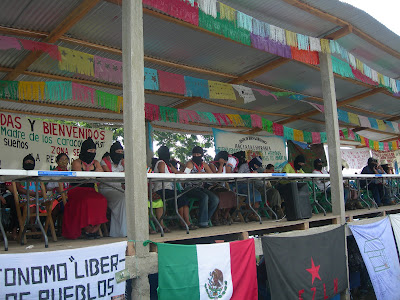
On a hillside, east of Altamirano, Chiapas, a metal roof arches over a massive stage surrounded by wooden buildings: Radio Insurgente, buildings for sleeping, a line of communal eating areas, and beyond them, a small cornfield and forested hills that go up for another 400 feet. The stage stands before a concrete platform which serves at times as audience seating, dance floor, or basketball court. Hung along the front is a banner which reads "Bienvenid@s / II Encuentro de los Pueblos Zapatistas con los Pueblos del Mundo [ Welcome / Second Encounter of the Zapatista peoples with the peoples of the world]" and bears the names of seven autonomous municipalities. This is Morelia, the organizing center or caracol (literally, "a snail," which grows by spiralling its shell ever outward) of the zone of Tzotz Choj, which comprises the seven communities and thousands of individual Zapatista "support bases," nearby members in non-Zapatista communities. To one side of the platform is the auditorium, a concrete-floored meeting hall with a wooden roof and open sides where as many as two thousand of us at a time listened to the Zapatistas and campesinos tell us the whys and ways of their struggles. Onstage, the Zapatistas sat at a line of tables, balaclavas or kerchiefs concealing their faces as they talked about building primary schools, or dividing the work in the milpas, or staffing the councils in the autonomous municipalities. And behind the stage is the office of the Junta de Buen Gobierno ("good government council" was a translation when we used English at all), where rotating representatives of the seven municipalities in the zone coordinate their activities, allocate the support of outsiders to efforts in need of it, and act as a court and dispute resolution group of last resort. Unauthorized by any external agency, the Zapatista system of autonomy is busily functioning, and has been deepening its path for at least fourteen years.

Morelia is just one of five caracoles, which are each home to one Junta de Buen Gobierno, schools, clinics, and all that is necessary for massive gatherings both among the Zapatista communities and with the outside world. This July, three of them, Morelia, Oventik, and La Realidad welcomed over two thousand of us into their world. The three caracoles are spread out over miles and miles of hills, pine and tropical forests, cornfields and gravel roads -- quite a lot of space. It's all the more spacious because of the lack of rapid means of travel across it, something that has probably saved the Zapatistas more lives and offered more autonomy than I can imagine.

At the encuentro, there were hundreds of voices, for days really, tracing their own personal work towards autonomous health and education systems, ways of coordinating between each other and managing outside support, efforts to revive local knowledge and to challenge the devaluing and oppression of women. The encuentro was first and foremost a giant collective report given to everyone in the camp. It was fascinating and exhausting, at times repetitive and at times deeply symbolic in demonstrating that so many people are working together.

Outside of the seminars, there was a massive community. 2,335 people registered as part of "the people of the world", while thousands more Zapatista activists, support bases, and community representatives were there. We danced together on basketball fields and lawns, constructed tent cities and slept in workshops and auditoriums, strung hammocks, hiked to rivers to relax, and above all shared stories and experience. Personally, I spent nearly all my off-seminar time talking with U.S. and Mexican activists other than the Zapatistas themselves, which was quite valuable and really the only way to meet one another as the presentations were nearly all by the Zapatistas, though a morning of presentations by Via Campesina--a global network of farmers and farmworkers movements--brought the camp to a high level of excitement.

Autonomy

If there is to be one word that sums up the Zapatista cause over the past 13 years in Chiapas, it is autonomy. Autonomy wasn't even one of the 13 demands raised by the EZLN when they rose up in arms on January 1, 1994. But it is impossible to understand what they mean by, "Democracy! Freedom! Justice!" without learning their vision of autonomy. By the 1995-96 San Andrés negotiations with the Mexican Federal Government, autonomous municipalities had begun proclaiming their existence across Zapatista territory and the National Indigenous Congress collaborated in drafting an accord which would allow any indigenous community in Mexico to define its own autonomous existence and to join with other communities in self-managed collectives. The government's signature in San Andrés, the advocacy of the Catholic Bishop Samuel Ruiz, the march of 1,111 indigenous representatives to the capital and numerous crowds filling the Zócalo in Mexico City couldn't make the Accord into law, but in the mountains of the Mexican southeast, they have been enacted nevertheless.

One face of Zapatista political action is dramatic. Defying the ranchers' White Guards, Zapatista communities seized numerous tracts of land as ejidos, to be worked collectively by communities. They uphold a demand for 10 percent of the revenues of federal contractors operating in the autonomous zones. And mass actions by thousands of women publicly confronted soldiers in bases near their homes in the late 1990's, leading some such installations to close and withdrawal. Many of the panel spoke eloquently of lost friends, neighbors, and comrades, of those who allowed their blood to be shed in the interests of their communities.

Yet these matters took up only a small portion of the discussion at the Encuentro. What people came to talk about for hours was "nuestra autonomía," their own ways of doing things — the Other education, the Other health, the Other agriculture — and the means by which these things are self organized. The Zapatista effort at autonomy is about detachment from official structures of the state, and they've been quite meticulous about this, especially in matters of health, education, and politics. In many cases, the separation from the state sounds unproblematic, even essential. Each presentation addressed the situation before 1994, when state social services in rural Chiapas could best be described as more neglect than service. What's more, the government has spent a good part of the last thirteen years engaged in low intensity attacks on them, and that Mexico has a history of one party rule organized by incorporating the various civil society organizations into the party. Given the role of state funding as a means for electioneering and cooptation in Mexico, you can see why the Zapatistas have opted to avoid it altogether.

Autonomy, however, isn't just about where funding comes from. It has emerged as an independent exploration of what exactly is meant by the Other health or the Other education. These are largely carried out by "promoters," people from each village who have attended secondary schools with the express purpose of returning to serve the community they come from. Some participants offered us a window into how this process came together. All Zapatista studies are somewhat self-directed, but the first group of young adults that went through secondary schooling were especially so, because they were the first generation of graduates charged with spreading the practical knowledge they amassed to the villages and communities they grew up in. They learned hygiene, basic health care, and sanitation so as to serve as health promoters, or they prepared themselves not just to teach within, but to create a system of primary education. In putting their knowledge to use, promoters are living out an ethic of service and of work directed towards both survival and political struggle. They are also redefining and extending the Maya custom of holding a cargo, or entrusted role, for which one is selected by the community. Teachers contrasted the system with the governmental system of memorization, competition, and preparing people for outside moneymaking jobs and emigration to the cities.

In doing these things, they are simultaneously rethinking and adapting them to their needs. Education is attuned to local life, to the history of struggle, to the knowledge that is needed to deal with local problems, and to maintaining language and culture. The health promoters are intensely involved in upgrading the logistics of day to day life to prevent disease--composting toilets and clay ovens that don't blow smoke in their users faces are big projects right now.

Multiple faces of oppression; one mask of resistance


What is it that the Zapatistas are resisting? As an outsider it would be easy to think of words: neoliberalism, the Mexican state, or five centuries of conquest. The Zapatistas themselves use a phrase -- el mal gobierno -- to encapsulate in one package everything that nuestra autonomía is not. If the Zapatistas strive to follow the principle of mandar obedeciendo -- When entering the Zapatista territory the welcoming signs say, “Here the people rule and the government obeys, ” -- for the mal gobierno it is the reverse. And in telling their story, any time during the Encuentro, from education in Oventik to bone-setting and midwifery in La Realidad to the overall balance of their struggle, a rhythm is repeated: before and after the conquest, in the time of our grandparents, before and after the 1994 rebellion. Memory, history, culture are recounted in terms of the beginning and the end of the mal gobierno.

The experience of those years included several different forms of oppression. One aspect is poverty even as enormous quantities of natural wealth — oil, wood, hydropower — flowed out from the region. In Chiapas, poverty means malnutrition, a shortage of doctors, pregnant women and sick people of all ages dying the long journey to find medical help. At the same time, indigenous Chiapanecos were made to live in a world where their knowledge was discarded. Maria de Jesus, president of one autonomous municipality near Oventik, spoke of how the conquest that meant a loss of pre-existing science, bought, and culture through dispossession and slavery, but also through the imposition of new ideas, laws, and government.

Their interactions with mestizos and whites during this period remind me of the Jim Crow South and the slave plantation. Plantations themselves were a big feature of Chiapaneco rural life. Knowing that many people have lost communal access to their land didn't prepare me for the testimony of what it was like to work full time for a landlord. Women especially recounted how landlords felt entitled to attack and rape them, and then to claim authority over peasant marriages. They proceeded to work both husbands and wives long hours, outside of which they had to attend to their own fields and care for their own children. Patriarchy, associated by some with outside power, also stemmed from "our own husbands and parents," who didn't provide women and girls with equal respect and even "treated us like animals."

Participation in Zapatista organizing has been an antidote to much of this. Their political action speaks powerfully to the outside world through the incredible mobilization of numbers and through collective work. What a landlord or an occupying military commander faces is massive crowds acting collectively behind anonymous masks. Yet that collective action — in the form of community assemblies, collective work, education, political mobilization, and the Zapatista Army — provides a space for redressing many of the specific harms of life as it existed before. And the creation of a universal "right to participate" in both community life and in this level has been an enormous tool in the struggle against sexism. This right effectively puts men who place demands and restrictions on their wives and daughters in opposition to the collective struggle itself, giving organized women a claim to press as they bring others out of the confines of their homes.

The Zapatistas have spoken of their balaclava as "the mask that reveals,” a symbol whose assertiveness and collectivity had made indigenous people visible once more as political actors and social beings. But listening to numerous people behind these masks taught me that while revealing, they also conceal differences in experience, oppression, and struggle that we must listen to attentively.

Poverty, resources, and solidarity

The morning after I arrived in Mexico, new figures were released on poverty in the country. The problems raised by economic scarcity are serious enough that they have defined three levels of poverty, the most severe being alimentary poverty, where one is unable to cover the cost of basic nutrition. On all measures, Chiapas, and particularly its rural areas, is among the regions hardest hit by this lack: 47% of the state is in alimentary poverty, while 75.7% are without secure rights to homes or land. At the same time, Chiapas' wealth is continually being trapped, piped, or transmitted through wires into the rest of Mexico and the profits of much of Chiapaneco commerce are sucked out with them. The process is both a component, and a miniature version, of how Mexican wealth flows to the United States and the larger world economy. This contradiction was the story told by Subcomandante Marcos in "The Southeast in Two Winds: A Storm and a Prophecy," a communique written before the 1994 uprising. It remains unresolved today.

Limited resources constrain nearly everything the Zapatista communities do. More than a lack of skills or training, the education and health providers talked about needing medicines, supplies, and ambulances. The difference between communities with a fair-trade-based flow of income and those exploited by middlemen is a mix of having outside contacts and having the resources to buy a truck. Poverty in Chiapas is a matter of life and death.

On the positive side, international solidarity has meant a significant flow of resources to Zapatista communities. The health care system has been enriched by a steady flow of volunteer doctors and donated supplies. People arrived to build schools or bring equipment. The operational fair-trade systems tie collective agriculture into networks of sympathetic consumers, and send a small flow of dollars and euros against the tide of extraction from Chiapas. Oventik has two Italian-purchased ambulances serving surrounding communities.

These are all serious, everyday matters, spoken of freely throughout the Encuentro. Those responsible for various autonomous services were frank and direct in naming lack of resources as a problem; coffee cooperative members actively called for new markets; and so on. Yet these issues are not centered by many Northerners interested in the Zapatista struggle. Those most inspired by politics of autonomy, of working from below and to the left, in the global North are often interested more in how to be autonomous FROM the exchange of money then achieving autonomy THROUGH the amassing of the resources necessary for it. Such a perspective can find much to admire in Zapatista praxis, which has an extraordinary reliance on collective work, communal lands, assembly-based decisionmaking and resources sharing, etc. And clearly something — many things, really — are being destroyed by the penetration of economic logic into all sides of Northern life.

However, disinterest in issues of money and resources also conceals privilege. We, as part of the world's wealthier minority, have to be prepared for honest conversations about sharing resources and transferring wealth and technology to the global South. Community-to-community relationships like those offered to the Zapatistas by people in solidarity are one important model. If we're serious about justice, we will have to think about how to massively scale them up. As mentioned earlier, the Juntas de Buen Gobierno make coordinating the use of outside resources a major part of their work. Teniente Coronel Insurgente Moisés contrasted this model with that of the United Nations (and, one can add, the entire "international development" world), which is accountable first to outsiders, and assumes the poor are incapable of making their own decisions or setting their own priorities. Direct solidarity is thus the Other Aid.

Similarly, the deployment of appropriate technologies can be a place for outside support. Lately, health promoters, at least in the zone of Tzotz Choj around Morelia have had been building dry compost toilets to reduce communicable diseases and ceramic stoves that prevent the respiratory illnesses that come from indoor wood fires. Lifesaving projects like these have only occasionally been the focus of international solidarity. Perhaps it's time for this to change.

On another front, we need to keep the shining example of Zapatista autonomy from reinforcing the capitalist value of "pulling yourself up by your own bootstraps." While it's true that enormous creative potential is unleashed by liberation from local hierarchies, confronting sexism internally, displacing profiteering middlemen, and so on, this is not the whole Zapatista story. The role of help from people inspired by their political vision, and the critique of how Chiapas' wealth is extracted by neoliberalism are important facets of their story as well. As we imagine a longer term future, we cannot settle for autonomy on its own. Mutual aid, recognition of the accumulated ecological debt and reparations for colonialism and forced servitude, expansion of land rights, and transfer of resources in the interest of equality should be part of that vision.

Read More!

Thursday, September 20, 2007

Towards the Intergalactica

a water tank in the Zapatista Caracol of Oventik

Help spread the word about the NYC Encuentro for Dignity and Against Gentrification being hosted by Movement for Justice in El Barrio on October 21st. This week Kolya Abramsky joins us again, this time to share specific ideas and context for advancing global anti-capitalist struggle:

Towards the Intergalactica
Beyond Networking - Building New Autonomous Global Relations of Production, Reproduction and Exchange
by Kolya Abramsky

The Zapatistas have called for a Third Intergalactica to take place, “from below and to the left”. This call follows two previous Zapatista Intergalacticas, self-organized international gatherings of several thousand people aimed at weaving a global network of grassroots struggles. The invitations to participate in these meetings were humourously extended to participants throughout the galaxy, hence the name. The first took place in 1996 in Chiapas, and the second in the Spanish state the following year. The first two Intergalacticas had a profound effect on inspiring, galvanizing and even giving some organizational form to a major new circulation of global struggles, which we have witnessed in the last decade. There are many good reasons to believe that the new process of global convergence and resistance called for by the Zapatista’s 6th Declaration of the Lacandon Jungle, issued through collective discussion in the Zapatista communities in the summer of 2005, could have a similarly important inspirational and catalytic effect in creating a space in which the next stages of global resistance can take shape and collectively organize themselves.

The current call comes at a moment in which two major and opposing trends are taking shape.

On the one hand, the last 10 years of global struggle and the War on Terror have provoked a profound loss of legitimacy for established institutions of power, such as international financial institutions, multilateral treaties, the nation state in general and its electoral systems and parties. In particular, the US state and its military apparatus are suffering a crisis of legitimacy, both beyond and within the US itself. As the US military fails to secure its war objectives in the face of Iraqi resistance, the US domestic political landscape has seen a massive surge in migrant (labor) struggles, and the first US Social Forum has taken place (as well as deep fissures evolving within the US military and political elites themselves). In parallel to this loss of legitimacy of established power, and also in response, there has been a great flourishing of self organized efforts to question and resist such power structures, frequently based on a confrontational approach to power rather than lobbying, and also based in principles of autonomy, diversity and non-hierarchical organizing. And, above all, such resistance is frequently globally networked, or at least internationalist in outlook, and often resonates beyond the immediate locality in which it occurs.

Yet, on the other hand, following on from massive success and visibility, the global networks are nonetheless seemingly incapable of slowing and reversing the rapid lurch towards an authoritarian global politics based on fear, coercion, militarism, racism and religious fundamentalism, a politics that is not just based on the whims of maniacal leaders the world over, but is also undeniably fostering a mass appeal at the expense of and in direct competition with the mass appeal of more emancipatory visions of social change based on autonomy, diversity and self-organization. Worryingly, existing international organizational processes which have played an important role in the last ten years, such as Peoples’ Global Action and the World Social Forum, seem to be in a form of at least temporary paralysis, both in terms of immediate activities at the global level, and also in terms of wider strategic, and long-term, approaches. Some people, both within and outside of movements, have even (boldly, to say the least) declared that the global movements are dead. Yet, in the midst of the supposed death of the global anti-capitalist movements, so too the World Bank, International Monetary Fund and the World Trade Organization also find themselves in the midst of deep crises, perhaps nearer to their own deaths than emancipatory movements are themselves ready to acknowledge, suggesting that rather than being dead, the movements are actually at a very strong point.

Rather than seeing globally networked anti-capitalist struggles as dead, perhaps it is more useful to recognize that they have reached some kind of limit in their ability to move forward, and are finding it increasingly difficult to go beyond their unexpectedly successful assaults on major summits of many of global capitalism’s key institutions (as well as large, but less successful, anti-war protests) in a way that deepens and expands the existing networks in order to make them functional enough to be able to create alternative social relations rather than just denouncing existing relations of power. Perhaps some specific, named organizational processes are dead. Or, perhaps, they can be revived in a useful way. However, ultimately, the names which organizational processes take is not important. What is important is that there is a meaningful process of global resistance. The organizational names will follow the struggles, not the other way around.

Given the enormous potential for new global processes that the current moment offers, it is important that this potential is not lost and that the process through which the Intergalactica is built is as solid and meaningful as possible. Importantly, this means that, despite the fact that time is of the essence, the process should not be rushed. Rather, it is important that it takes shape at the pace necessary to enable a broad participation from many different struggles from around the world.

How can such an invitation be taken up? What obstacles might exist to realizing such a process?

Anticipating Capital and State power’s response to autonomous global resistance

Historically, capital and state power have responded to popular resistance through the combined use of 3 major strategies.

Populations have been divided from one another, both within countries and between countries, in order to prevent unity of struggle. Especially important has been capital’s ability to prevent global circulation of struggles by maintaining a world-system divided into nation states. The world-wide division of labor has been hierarchically structured, based on imposed (and continually reimposed) divisions based around (especially, but not exclusively) race, ethnicity and gender hierarchies, as well as those between waged and unwaged labor. When considering the global division of labor, certain (minority) sections of the world’s population have been implicated in the exploitation and discrimination of certain other (majority) sections of the world’s population, due to gaining direct or indirect material rewards from their position in the hierarchy. Another crucial divide throughout history has been the citizen/non-citizen divide. Perhaps the most glaring example of this is the so-called post-World War II “welfare state” model which has provided large sections of the populations in the capitalist center (especially, but not exclusively, white male unionized workers) with greatly improved material standards of living at the expense of the great majority in peripheral countries, as well as people of color and unwaged (especially women) workers within the core countries themselves.

The second major strategy employed in response to social struggle has been cooptation that has integrated struggles, by partially giving in to certain demands for social, economic and political reforms while not substantially challenging private ownership and profit relations, political decision making, and labor control mechanisms that have defined capitalist (and imperialist, patriarchal, racist…) social relations. In its most ingenious forms, especially post-World War II Keynesiansism and Developmentalism, not only was social struggle bought off, but it was also actually harnessed so that, safely channeled, protest could actually contribute to economic growth.

Last, but not least, has been repression. Those resistances which could not easily be integrated or bought off with reform have simply been crushed and intimidated out of existence, involving mass imprisonments, torture, and political murder, as well as war.

These three strategies are not employed in isolation from one another, but in careful combination. They are implemented with varying degrees of success (from the point of view of capital and state power), and never permanently.

In the current context of global resistance we are already in the whirlwind of these three responses, and this whirlwind is only likely to intensify in the not so distant future. The degree to which emancipatory struggles are able to anticipate, prepare for and confront these strategies will greatly determine how successful the movements are in building viable long term emancipatory social relations.

Perhaps one of the most important goals of the Intergalactica could be to collectively create a global space for struggles from around the world to seriously address these concerns. However, before the Intergalactica process is in a position to do this, it is important that relevant movements and struggles are aware of and participating in this process.

A key question that needs to be addressed before addressing any other question is who will take part in the process of building the Intergalactica and on what basis, and the questions as to how to build the Intergalactica and what its political contents and themes will follow on from there.

Unity against division: who should the Intergalactica strive to include?

For a global process such as the Intergalactica, it is especially important that people from as many countries as possible are involved. In particular, there is the need to pay special attention to overcome divisions that are being fostered within the world-economy itself. Unless intentionally addressed by emancipatory struggles these divisions are likely to be reproduced within global networks themselves. In particular 5 types of divisions currently stand out, divisions which are likely to become much deeper and more damaging in the near the future:
  • The so-called “Clash of Civilizations” is a process which could turn out to have similar divisive effects on global struggle as the Cold War did, in which (on a greatly uneven and hierarchical basis) people from “the west” and “the Arab world” are trained to fear, distrust and hate one another, divided by ignorance and encouraged to align themselves to one or the other side of absolute religious and cultural divides based around “good” and “evil”. Crucially, until now, “the Arab world” has hardly been involved in (contemporary) secular global networks of anti-capitalist struggles, and within these regions, religious based struggle seems to have had much more of a mass appeal than anti-authoritarian global anti-capitalist networks. Furthermore, these global networks still remain largely ignorant of and isolated from struggles in the Arab world, though the situation in Palestine, Iraq and Afghanistan is changing this slowly and some interesting links have been made.
  • Africa has been exploited and marginalized at the lowest levels of the hierarchical world-economy. Unfortunately, sometimes in global anti-capitalist networking processes, these processes of marginalization have also been reproduced. A discussion of reparations for slavery for Africans and their Diaspora is still very low on the agenda of most global networks, and most discussion around debt is still based in the language of pleading for “debt forgiveness” rather than demanding non-payment of illegitimate debts. The multiple wars in Africa also have very little prominence within global networks. The fact that the last two World Social Forums have taken place in Africa (Nairobi and Bamako, the latter as part of the 2006 Polycentric Forum) and that the Forum for Food Sovereignty also took place in Mali last year has perhaps slightly improved this situation. However, African struggles are still highly marginalized within many global anti-capitalist networking processes.
  • The Citizen/non-citizen divide, despite sparking a vast amount of self-organized struggles throughout the world, especially in North America and Western Europe, makes it difficult if not impossible for undocumented migrants to travel to international meetings, gatherings, and protests and to make any form of direct exchanges with movements in other countries. Any form of contact with struggles in other countries must, by necessity, always be indirect, either through web, texts, videos, radio etc, or through intermediary (documented) supporters, who may or may not be mandated by the undocumented people concerned. This reliance on indirect and mediated communication presents profound challenges to self-organization and unmediated self-representation. Movements will have to think of creative ways to overcome this division itself. And, perhaps additionally, to fundamentally challenge the concept of expanded citizenship as an emancipatory route. Can citizens even exist without the parallel existence of non-citizenship?
  • Rival power/imperialist blocs. Rivalries between regional power blocs have increased in recent years, and are likely to continue doing so in the future, especially along the lines of tensions between USA, China and EU countries, but also other countries including India, Brazil, Russia, Japan and the Koreas and the alignments that these latter countries’ governments and their capitals choose in relation to the former countries. Currently it is still fairly easy for information and people to circulate between these regions, however, regional and national protectionisms (as well as military tensions) could emerge which make such contact more difficult in the future. Importantly, until now, Chinese struggles, which are accelerating rapidly in parallel to China’s growth as an economic power, have been more or less entirely absent from global anti-capitalist networking process. However, in recent years there have been some intentional contact making processes outreaching towards Chinese struggles driven by people active in a range of different global networks, and the fact that the last WTO summit took place in Hong Kong also provided an important moment for connections to be made between different struggles, but there is still a great deal of work to be done in this area.
  • The final type of division to be dealt with here are the divisions that exist between activists from countries that have hostile governmental relations to one another. For instance: Israel/Palestine, Israel/Lebanon, Israel/Iran, North Korea/South Korea, India/Pakistan, Iran/USA, Iraq/USA. International spaces have great potential to overcome such divisions, as, in practice, the “neutral territory” which they offer may be some of the only spaces where activists in such situations are actually able to come together, since very often it is incredibly difficult (either in practical terms or because it is simply illegal) for them to come together in their own countries. However, while there may have been “bilateral” efforts between two specific conflicting countries, this theme has until now only been rarely addressed within a more global framework of struggles.
As a new global process, it is important that the Intergalactica seeks to overcome some of these divisions as much as possible, or at least acknowledges that they are important global divisions to overcome, in order to strengthen global unity of emancipatory struggles in the face of attempts from capital and state power to divide the global circulations of these struggles and the people involved in them. However, high levels of participation in the Intergalactica from these regions, countries and sectors are very unlikely to happen spontaneously, and may in fact require an intentional and targeted preparation process that seeks out contacts and collaboration with struggles in these parts of the world, not just relying on existing contacts but rather trying to build new relationships where none currently exist. There are many obstacles that will have to be overcome in this process, not least of all language ones.

Beyond networking - building new autonomous global relations of production, reproduction and exchange

Let us move from the question of who will participate in the Intergalactica to the how will the Intergalactica be organized and on what themes.

At the start of this article, it was asserted that current global networks and struggles are not dead, but rather are in the difficult and slow process of reconfiguring themselves in order to build on their big successes and overcome their limits in order to effectively move into a higher phase of struggle. Global networks do work, sometimes extraordinarily well. In a remarkably short time period (the first global day of action against the WTO took place just under ten years ago in May 1998) global networks have been constructed which have become excellent at organizing large global meetings, conferences, global days of action on common themes, calling for emergency solidarity actions in support of particular local struggles, as well as translating and circulating up-to-date and accurate information and news throughout the world in a short space of time. These processes were almost completely unheard of ten years ago. Now they are regular, daily occurrences. Indeed they have sometimes become so regular that they are often taken for granted, and hardly noticed, to such an extent that people can even boldly proclaim that global networks are dead.

However, while not being dead, these networks are still very limited, and there is very little discussion of the concrete limitations that do exist or of how to overcome them. It is one thing to bring activists from many different countries and struggles together for a face-to-face meeting or protest that takes place over a very short and specific time period, normally of a few days only. However, it is quite another thing to actually build long term deep social relations between struggles at the global level, relations that create fundamentally different relations of production, reproduction of livelihoods and exchange and that go beyond the nation state and market as forms of organizing social relations. Until now, most global relations between struggles in different parts of the world have been quite ephemeral and highly superficial, often relying on small numbers of specific individuals rather than being appropriated by larger numbers in the respective movements. At this stage in the young networks, this state of affairs is not especially surprising, due to many different barriers including access to resources for travel and regular computer based communication, foreign language skills, detailed knowledge of the world-economy, the ability to take time away from local struggles and immediate day-to-day concerns, etc.

However, while not surprising, this situation is nonetheless highly problematic. It has created a major bottleneck for movements’ abilities to go beyond networking and protest (denunciation) in order to construct long term alternative relations. This bottleneck means that global networking processes are not nearly decentralized enough, especially in relation to their own rhetoric of extreme decentralization; nor are they deep enough in terms of their ability to sustain meaningful exchange and mutual support processes. Furthermore, their reliance on small numbers of individuals makes them extremely vulnerable, both to the inactivity of specific individuals and to cooptation and repression (individuals are easier to kill, imprison and buy off than broader collective processes). Above all, global movements are still a very long way from constructing social relations that go beyond both the nation state and world- market, and in many cases (especially in the imperialist countries with a strong social-welfare state), there is still great dependency on state structures.

While the construction of alternative relations of production, reproduction of livelihoods and exchange are frequently at the centre of specific local struggles (especially land related struggles in Southern countries), these relations almost never extend to the regional or global level, and where they do (such as direct exchange coffee) they still have a very small reach and are limited to specific products (often artesanal). Global networks are still far better at spreading news and coordinating protests in different parts of the world than they are at spreading products, people, skills, financial and technical support. (These latter set of activities are often occurring, but still remain, for the most part, within the context of fairly paternalistic NGO activity that is based around the premise of reform and integration into existing power relations rather than in a horizontal politics based on autonomy, solidarity, diversity and a confrontational approach to power). Overcoming these bottlenecks in global networking processes would take horizontal autonomous self-organization to new levels in terms of building global alternatives that go beyond both the nation state and the market. There is an urgent need for movements to tackle these difficult tasks.

It is in this context that the Zapatista call for another Intergalactica must be understood. The Zapatistas themselves have fought a long social struggle that has spent many years in the laborious and painstaking process of constructing long term autonomous social relations based on collectively taking over land, one of the fundamental means of production and reproduction of people’s livelihoods. The invitation to participate in constructing a global Intergalactica “from below and to the left” comes from a clear understanding of the urgent need to intensify and strengthen anti-capitalist struggles and the need to deepen the human relations of solidarity on which the networks of struggles that have already been built in recent years are based, going beyond the limitations described above.

Building the Intergalactica slowly but solidly

Until now, the process outlined in the 6th Declaration has got off to a seemingly solid start. The Intergalactica itself is slow in taking shape, arguably a very wise move given that the process is intended as a deep, long-term process rather than a superficial, immediate, “one off” show-event. So far, the process has been predominantly driven forward by the Zapatistas, with a strong response coming from different groups around the world. To date, there have been five main “steps” since the publication of the 6th Declaration in the summer of 2005. These are: the first and second stages of the Other Campaign within Mexico itself, an initiative aimed at building a strong country-wide non-electoral political process from below and to the left, with the first part taking place in parallel to the Mexican Presidential electoral campaign; the first and second Encuentros of the Zapatista Peoples with the Peoples of the World (December 2006/January 2007 and July 2007); and a period of consultation in which struggles around the world were able to make proposals for the Intergalactica. A number of further steps have been planned for the near future. In October 2007 there will be an Encuentro of the Indigenous Peoples of the Americas convened by eight indigenous organizations, including the Zapatistas, in Sonora, Mexico. In December 2007/January 2008, an all women’s Encuentro will take place in one of the five Zapatista Caracoles (autonomous self governing bodies), dedicated to Comandanta Ramona who died last year. These events are all events that are important in their own right. However, none of them are the Intergalactica proposed in the 6th Declaration. Rather, they can all be understood as steps along the way to it.

Let us briefly evaluate the international aspects of this process. Narco News, the main English language website following the Other Campaign and developments since the Sixth Declaration was issued, has links to Other Campaign related materials in 8 languages, interestingly, including Farsi. Already, before the first Encuentro of the Zapatista Peoples with the Peoples of the World took place in Chiapas last December/January, a decentralized process of preparatory meetings and other activities had taken shape throughout much of Europe, South, Central and North America in response to the Zapatista call. Between July 2005 and July 2006 (the period of consultation), 19 different activities were reported in 16 cities from 9 countries. Importantly, this included several within the USA, involving close overlap with those involved in the powerful migrant struggles that are erupting there. Many of them are Chican@s and Mexicans involved in the Other Campaign from within the USA, what has been dubbed “the Other Campaign on the Other Side”. Whilst most of these meeting and initiatives have been fairly conventional processes of one-way solidarity to what is occurring in Mexico, some of them have gone further, employing the language and perspectives of the Other Campaign to engage in activities relating to local issues. Three important examples of this have been a local consulta organized by an immigrant organization Movement for Justice in El Barrio, in Spanish Harlem, New York and two different border camps against the US and Mexican border, as well as the complementary, although not explicitly linked, “Another Politics is Possible” presence at the US Social Forum in Atlanta this summer. From these meetings and activities, a number of proposals have emerged for how the future Intergalactic Encuentro should be organized and what its contents should be, which will be addressed later in this article. Although not without its limitations, which will be addressed later in this article, it is clear that there is a strong international process emerging around the Intergalactica.

The two Encuentros Between the Zapatista Peoples and the Peoples of the World which have occurred to date both drew several thousand people to the autonomous Zapatista Caracoles in Chiapas, about half from Mexico and the other half from close to fifty countries from around the world. The first meeting was held in one of the Caracoles, Oventic, over four days, and the second held in 3 Caracoles (Oventic, La Morelia and La Realidad) over nine days. The two meetings were opportunities for the Zapatistas to present their grassroots achievements of autonomy and self-government to people in struggle from different parts of the world, as well as for the Zapatistas to learn about struggles in other countries.

In the first Encuentro, members of the Juntas de Buen Gobierno (Good Government Councils) presented Zapatista experiences in the following areas: autonomy and other forms of government; the other education; the other health; women; communication, art, culture and the other commerce; and land and territory. The final session of the first Encuentro was devoted to hearing proposals from around the world as to how, when and where to build the Intergalactic Encuentro, proposals which had emerged from the period of international consultation opened by the Zapatistas. Interestingly, the strongest participation from outside Mexico probably came from the USA and Canada, including a large number of Indigenous and First Nations organizations from these countries, as well as organizations active in the Other Campaign on the Other Side.

The second Encuentro built on the first Encuentro, going into greater depth about the nuts and bolts of autonomous organizing, with presentations by promoters and other community activists from each municipality around the themes of autonomy, collective work, health, education, and women. A very impressive delegation of Via Campesina representatives from major peasant organizations worldwide participated in this Encuentro, from: Brazil, Bolivia, Honduras, Dominican Republic, USA, Canada, Quebec, Basque Country, India, Thailand, Korea, and Indonesia. Unfortunately the one African representative, from Madagascar, was denied a visa. One day was devoted to speeches from most of the Via Campesina delegates. The second Encuentro did not have a session devoted to the Intergalactica, and in fact there was almost no mention of the Intergalactica, clearly a deliberate decision on the part of the Zapatistas. On the other hand, there was an important unofficial, and self-organized, side meeting which involved around 50 people living in the US, and one of the major themes of the discussion in this meeting was the need to have a similar process to the Other Campaign within the USA itself, which rather than focusing on supporting and participating in the process within Mexico (itself a very important task), would aim to start a long term process to building a form of grassroots political process that goes beyond electoral politics within the USA itself. Mexicans and non-Mexicans alike were proposing this.

In a number of ways the second Encuentro built on the first, slowly deepening the global process that these Encuentros aim to be constructing. In addition to a more in depth presentation of how the Zapatistas have organized over the last years, the second Encuentro was a space for greater participation from different Zapatista communities, with people from each municipality presenting, and in three different Caracoles instead of only one. This was an important space to give large numbers of Zapatistas direct experience with international meetings, with the many different forms of participation that this involved, from speaking on a panel before thousands of people, to preparing cultural events, to organizing the logistical side of large international gatherings, to international “baile popular” (popular dance). Perhaps the most important deepening of the process could be seen in the Via Campesina participation, giving the Encuentro the international scope and presence of mass-based grass roots organizations that the first Encuentro had lacked to a degree (in the first Encuentro there were few, if any, participants from Asia and none from Africa). This process of building specific sectoral alliances along the road to the Intergalactica had been building over time, with Via Campesina having distributed Zapatista corn at the World Forum on Food Sovereignty which took place in Mali earlier this year. The decision to have an indigenous peoples Encuentro and a women’s Encuentro later in the year is a further step to building important sectoral links, taking the time necessary to ensure that the process is firmly anchored in real struggles before moving on to the Intergalactica itself.

Another important progression was the deepening of the revolutionary discourse. First of all it is important to point out that neither the Sixth Declaration nor the Encuentros themselves have any trace of lobbying about them, nor of defining people in relation to the state. The word “citizen” is refreshingly completely absent. The first Encuentro repeatedly stressed the need for resistance to find ways of self organizing in order to come together in common struggle. An emphasis was on the need to organize resistance which is already occurring throughout the world. The second Encuentro started with a pre-Encuentro event the night before the Encuentro itself at the indigenous training center, University of the Land in Chiapas, which in no uncertain terms laid out the terms of struggle, setting the scene for the main Encuentro. The Zapatistas recognize that there are three main ways of embarking on anti-capitalist struggle: establishing alternative consumption patterns, establishing alternative trade patterns or establishing alternative production relations. They have decided to go for establishing alternative production relations, namely collectively taking over the means of production. Having taken over the land, they stressed the importance of rural and urban unity in struggle, so that in addition to taking over land, it will become possible to take over factories in the future. Whilst respectful of the other methods of trying to create non-capitalist relations, taking over the means of production is, in their opinion, the most direct way of struggling against capitalism and creating alternative social relations. For an Intergalactica coming “from below and to the left”, such a shift in rhetoric is a very important challenge to global movements who seem very timid around discussing (and above all acting on) the question of means of production. It is an especially challenging discourse for struggles in the capitalist core countries, where that idea was abandoned years ago in favor of some form of social-democratic welfarism.

On a more critical note, there was virtually no one present from Africa, or the Middle East and Arab world. Furthermore, with the exception of the large Via Campesina organizations, large numbers of the participants came representing small collectives and individuals (who are completely welcome in the process). Another weak point was the proposals made for the Intergalactica during the first Encuentro, the majority of which were quite chaotic, confused and still very superficial, as well as predominantly coming from individuals or small collectives with no real organizational backing. Frustratingly, the Zapatistas remained mysteriously quiet about their own proposals for the Intergalactica, proposals that judging by how the Other Campaign has developed to date in Mexico and how the two international Encuentros have gone, are almost certain to be very highly thought out and inspiring. However, the process, which is a very ambitious one, is only just beginning, so none of these criticisms are either very surprising, or very worrying.

Next steps towards the Intergalactica

For the Intergalactica to turn into a long term process that significantly contributes to building new social relations at the global level, it will be important that it is a participatory process, driven forward by struggles across the world, constructed through a process of dialogue and exchange. The Zapatistas have set the ball rolling, with a directed invitation. However, the Intergalactica is not just the responsibility of the Zapatistas but of all those who identify with it throughout the world. Active rather than passive participation from these different struggles will be what gives the process real depth and meaning. This includes the need for a collective global discussion and preparation process, based in decentralization and autonomous self-organization that aims to define who will participate in the Intergalactic, the process by which it is organized, what its purpose and contents will be, where it will take place and when.

As mentioned above, it will be particularly important to make efforts to include people from struggles in Arab countries, Africa, China and countries whose governments have mutually hostile relations with one another. This is likely to require going beyond existing contacts, making special efforts at both linguistic and political/cultural translation. It will also be important to include undocumented migrants, especially from areas of the world where there are strong movements, such as in the USA, Canada, European Union countries and Australia. Wherever the Intergalactica takes place, it will be very difficult, if not impossible, for undocumented migrants to attend. Solutions to this problem could include making efforts to have participation from as many delegated representatives of undocumented migrants who are able to travel at the Encuentro as possible, as well as organizing parallel and linked Encuentros in countries with large numbers of undocumented migrants for those unable to travel due to their undocumented status. Discussions and proposals from these more localized Encuentros could feed into the main Intergalactica process, and vice versa. In fact, such a proposal was one of the more interesting proposals which came out of the first Enceuntro of the Zapatista Peoples with the Peoples of the World in the session on the Intergalactica.

Based on the above analysis, I would like to propose that it would seem to make sense for a number of broad thematic strands which could form the basis of the Intergalactica discussions, based on long term strategic and organizational concerns.
  1. How to both expand and deepen global networks, on the one hand to include geographical (as well as sectoral) areas that are scarcely part of global networks, and on the other hand increasing the functional strength of existing networks, so that they can move beyond exchange of information and coordination of protest towards building long term autonomous and decentralized livelihoods based on collective relations of production, exchange and consumption. This could include initiatives aimed to develop concrete tools for deepening connections between movements, such as: long term activist exchanges (especially South-South), language training, and exchanges about international networking processes etc.
  2. Exchange of experience on how to avoid, prepare for and respond to repression in a way that simultaneously is based on a maximum respect for life and dignity, but also in a clear and unequivocal affirmation of oppressed peoples’ right to choose what they themselves consider as appropriate means of self-defense against aggression, both from internal repression and from external military aggression.
  3. Exchange of experiences on how to avoid cooptation – especially new forms of protectionism and racist deals, dangers of regional integration, reforms that grant reforms but do not challenge global market, etc.
  4. Exchange of experience about differing approaches to the state. Rather than having absolutes about taking state power, or not taking state power, a discussion process about what actually works, how organizations make decisions in terms of how to approach the state, factors to take into account, compromises to make, etc.
However, beyond general frameworks, the contents and methodology of the Intergalactica will need to be decided on through a slow but solid collective and participatory discussion process involving movements from many different social sectors and many different countries, rather than being dreamed up by a few individuals in an office somewhere. This means that it will be important to take the time to build such a grassroots global process long before the Intergalactica occurs. It is unlikely to be effective if it is a last minute process, with organizations, groups and individuals deciding to go to the Intergalactica only one week in advance. Rather, the preparation process itself needs to be built up from really existing relationships, relationships that in many cases perhaps still do not exist, relationships based on real human contact, familiarity and trust, especially between organizations from Southern Countries. This could include, for instance, a series of prior visits and face to face exchanges between different struggles, as well as possible language training to facilitate the process and cut out the need for intermediaries (who normally come from Western Europe and North America). Such a process, in addition to being time consuming and difficult, is also likely to be very expensive, which is another reason for starting early on the global process of slowly constructing the Intergalactica from below and to the left. Above all, this preparation process should not be seen as just the responsibility of the Zapatistas themselves, nor just of Zapatista solidarity organizations, but of all those organizations and individuals who see themselves as adherents of, or inspired by, the Sixth Declaration.

Similarly, the date and location of the Intergalactica cannot just be dreamed up out of thin air. For it to be an effective and meaningful process, movements themselves will need to offer to host it, and propose the time and location according to a realistic assessment of whether, where and when they themselves are able to organize it. The proposal should not come from outside a country, or a movement. For instance, some of the earlier proposals that were read at the first Encuentro, were Europeans proposing that the Intergalactica should take place in Bolivia and other similar ill-thought out proposals.

Concrete immediate steps could include:
  • Continuing with already existing efforts at translating and, above all, disseminating of the 6th Declaration and Encuentro materials in different languages. It is already circulating well in the Spanish and English speaking world. Arabic and Chinese could be important next steps.
  • Deepening already existing collective discussion processes about what people see as the purpose of the Intergalactica.
  • Initiating contact-making visits and exchanges.
  • Organizations discussing whether they would like to offer to host the Encuentro, and if so, when.
  • Starting on fundraising for travel costs, etc.
The above does not need to be implemented in a centralized way, but rather can take place in a decentralized and autonomous way. However, coordination will be important. The more that different organizations take it on themselves to do inspiring efforts towards the Intergalactica, the faster the ball is likely to roll.

Read More!