The Zapatistas’ Sixth Declaration in the US and the World
By RJ Maccani, September 2006
(Originally appears as Part 3 of 3 for Left Turn's Stories from the Other Campaign and a different version will appear in issue 3 of Upping the Anti)

*ALSO! Use this pamphlet for organizing:
What does the Sixth Declaration of the Zapatistas have to do with You?
INTRODUCTION
The Zapatistas, an army of indigenous Mayans and their support communities in Mexico’s southernmost state of Chiapas, have had a profound influence on people’s movements around the world. From their armed uprising on New Years Day in 1994 to their hasty transition less than two weeks later to an armed, but militantly non-violent, political movement, to the release of their Sixth Declaration of the Lacandon Jungle last July and the subsequent launch of the national movement known as the “Other Campaign,” the Zapatistas have continuously analyzed their experience and transformed their struggle for freedom, justice, and democracy. Recognizing that the systems that oppress them transcend Mexico’s borders, the Zapatistas have also consistently reached out in the process to join with like-minded people around the world to build a global network “for humanity and against neoliberalism.” This global network, which they sometimes refer to as the “Intergalactic,” and our relation to it here in the US, is our focus here.
From an initial discussion of the pivotal role the Zapatistas have played in world politics for over a decade now, we will turn to other left forces that have emerged since their uprising, namely the World Social Forum and populist governments in Latin America, and then to an exploration of the complex ways in which the Zapatistas relate to electoral politics and, more generally, state power. With an eye all the while towards what we in the US are doing and the challenges we face. The second half begins with a look at why many different forces in the world are adopting the network model of organization, moves from here to look at the specific impact that the Zapatistas have had, and continue to have, on movements here in the US, and from there to a look at some of the challenges we have faced as organizers here, and some of the opportunities we look forward to now as we continue to work to turn things around, as we can hope that building the US Social Forum and the Intergalactic will be. From there we will move finally to the growth and activity of the Intergalactic network that has emerged with the release of the Zapatistas’ Sixth Declaration and ultimately, in conclusion, inspired by the Zapatistas, to a bit of poetry.
What follows is meant to be more informational and inspirational than prescriptive. It is meant, in this spirit, to provoke conversation, to help to move us to commit or commit further to being more than mere consumers of information, to being organizers as well as analyzers, to being the makers of history, as the Zapatistas say, “from below and to the left,” if for no other reason than those who are accustomed to making history now, the rich and political classes that is, are destroying everything.
BEFORE THE INTERGALACTIC
As Omar Olivera Espinosa from the Oaxacan teachers’ union and Radio Plantón pointed out to me, the left was in a bad place when the Zapatistas rose up in arms on January 1, 1994. The fall of the Berlin Wall, a little more than four years earlier, symbolized failure for the left globally—not just the political defeat of the Communist bloc, but that bloc’s failure more generally to produce a viable, desirable alternative to capitalism. In Latin America, the electoral defeat of the Sandinistas in Nicaragua, in 1990, and the signing of the peace accords between the FMLN and the Salvadoran government in 1992, further confirmed this defeat. In Mexico, the Institutional Revolutionary Party (PRI) government, under the guidance of President Salinas, was liberalizing trade and investment and privatizing at a rate unparalleled in any other part of the “developing world.” By the end of 1993, most Mexicans believed that trade liberalization and foreign investment would pull the country into the “First World,” or, if not, saw the neoliberal path as nevertheless inevitable. Then came the Zapatistas.
WHEN THERE ARE NO ALTERNATIVES,
IT BECOMES NECESSARY TO MAKE THEM
Out of this miserable climate, the Zapatistas marked a new era for the left. Rising up with “fire” and with “wind”—their arms and their words—they sought not to seize power in Mexico, but rather to depose “the perfect dictatorship” of the PRI, and open up a space for the Mexican people to decide democratically their nation’s course. This was the first sign to the rest of the world that they were doing something different. Next came the ironic and poetic communiqués of their spokesperson, Subcomandante Insurgente Marcos. As Laura Carlsen points out:
… to speak of dignity, of humanity, of democracy, of justice, was something that many movements considered bourgeois words, or at least strange … the renovation of politics and language … Zapatismo was a new form of expression, of giving the people the floor … language that obeys a reality, a desire not to remain only in words.
Since emerging aboveground over twelve years ago, the Zapatistas have managed to mobilize nationally and internationally, and not only survive, but grow and adapt. In both their words and their practice, they blur the conventional binary distinctions of Western political thought to create effective political action. They are armed and peaceful, indigenous and Mexican, particular and universal.
As a central point of reference for rebels around the world, the Zapatistas have helped to change the homogenizing narrative of “the proletariat.” While the Other Campaign is a re-vindication of class struggle, in that it is anticapitalist and looks below to “the simple and humble people who struggle” to solve the crises of Mexico, the proletariat it convenes wears Joseph’s proverbially amazing Technicolor dream coat.
Inherited from the European left tradition, the conventional narrative of the proletariat asserts that before capitalism can be overthrown and a post-capitalist future realized, humanity must go through a process by which capitalism tears us from the land and sends us through the factory, stripping us of our prior identities so that we become primarily “workers,” on which common ground we would then find sufficient unity to overthrow capitalism (a view informed, arguably, by white supremacist or at least Eurocentric thinking, consciously or unconsciously). According to this way of thinking, unity is achieved through homogeneity not only at the level of identity or material conditions, but in interpretation and action as well. Hence the incessant battles over “correct thought” or “the line” within large sectors of the left, and the frequently authoritarian forms of education and decision making implemented in revolutionary efforts.
By contrast, the Zapatistas reach out to many and all “different” people to join them in struggle, not only workers, but the indigenous, farmers, the unemployed, women, youth, queer folks, in short, all those who, in one manner or another, experience exclusion. And, with respect to the workers, the Other Campaign has found that some of the most radical of the workers’ movement are the “new proletariat,” that is, young, indigenous, and outside of the traditional unions. Is this not as it is for us on this side of the Rio Grande? What the Other Campaign proposes is that all of Mexico’s excluded, inside and across Mexico’s borders, join together in one movement, with their bodies, thoughts, dreams, and self-determination intact. In this respect, the Other Campaign is a reflection of the Zapatista vision of “a world where many worlds fit”—each person or group finds their place in the movement and defends it as their own. With a focus on listening and autonomy, the Zapatistas seek to build collective action. Al Giordano of the Narco News Bulletin has usefully dubbed this “class struggle with a decentralized, autonomy-all-around twist.”
In this spirit, eight months after the 1994 New Years uprising, the Zapatistas opened up a space in their territories in Chiapas for all the excluded of Mexico to come and begin to chart a new path for Mexico called the National Democratic Convention, the first of many national initiatives, the most recent of which is the Other Campaign. In 1996, they hosted the “Intergaláctiko,” or “Intercontinental Encuentro for Humanity and Against Neoliberalism,” which brought together over 5,000 rebellious people from forty-two countries, and which paved the way for the current Intergalactic initiative of the Sixth Declaration of the Lacandon Jungle.
Just as Mexico and the Mexican left have changed greatly since the 1994 uprising—the former ruling party, the PRI, are now weaker than two other parties, and the Zapatistas are part of a powerful national anti-capitalist movement—the world around Mexico has changed greatly as well, and with it the global left.
GATHERING GLOBAL REBELLION
When the Zapatistas convened the first Intergalactic in 1996, there was nothing like it in the world. It became a moment to regroup, rethink, and remobilize anti-capitalist resistance in the era of neoliberalism. The following year, a second Encuentro was hosted in Spain. Inspired by their conversations in these Encuentros, movements from around the world decided to form the network Peoples’ Global Action Against Free Trade and the WTO (PGA). The original conveners of the network were peasants’ organizations from India, Brazil, and the Philippines, indigenous movements from Nigeria, North America, and Oceania, union workers from Nicaragua, the Zapatista Front of Mexico, a mothers’ organization from the Ukraine, and youth organizations from throughout Europe.
PGA’s founding conference was held in February of 1998 in Geneva, Switzerland, and brought together over 300 delegates from 71 countries. It was there that the now ubiquitous Global Days of Action against the meetings of the elite were born. Building off of two decades of revolts against “structural adjustments” in countries around the world, they started with global protests against the spring meetings of the Group of 8 in Birmingham, England, and the World Trade Organization in Geneva. As global days of action continued to ricochet around the world, they gave new meaning to the names of places like Seattle and Prague, helping to form a common language among rebellious people gathering regularly to confront neoliberalism.
The flavor of the summit protests themselves became another signifier of the emerging global culture of resistance. Emphasis was placed on making room for many different forms of protest, from blockades and property destruction to non-confrontational marches and alternative forums, another reflection of “a world where many worlds fit.” The Internet and cell phones were utilized to generate and communicate information and decisions in a rapid and decentralized fashion. Consensus decision-making, whether in convergence spaces or affinity groups, was the norm. Confrontational, non-violent direct action revealed the face of global capitalism. From the independent media centers to the medical and legal collectives, autonomous alternatives were under construction. From the global gatherings to the summit protests, the polymorphous spirit of Zapatismo was in the air.
On the downside, here in the US, activists who were primarily college-educated and white, without a broader social base, dominated the movement that grew around the summit protests after Seattle. Specific tactics and postures and long consensus meetings were often prioritized over allowing the movement to evolve and grow with the rebellious trade unionists and poor folks who were taking to the streets as well.
GLOBAL TURNING POINT?
Less than a month before the famous “Battle of Seattle,” a third Encuentro, referred to as the “Second American Encounter for Humanity and Against Neoliberalism” (the first being the original Intergaláctiko in Chiapas), was held in the Amazon capital city of Belem, Brazil. It was originally called for by a wide array of Brazilian organizations, including Zapatista solidarity and anarchist collectives, black consciousness/power and indigenous rights groups, Workers’ Party (PT) members, the state-level chapters of the Movement of the Landless (MST) and the Unified Trade Union Federation (CUT), among many others. Its organization became so dominated by the City Council of Belem, however, a “left faction” of the PT, that by the time of the actual Encuentro, many chose to withdraw, including the MST, who accused the Belem City Council in particular of using the Zapatistas’ popular image to promote themselves in the upcoming elections.
The moment marks an early break within the emerging, globally coordinated resistance, between those seeking to build popular power and those primarily focused on holding state power. Although in attendance, the Zapatistas remained publicly above the fray, and did not endorse another Intergalactic Encuentro until they released the Sixth Declaration, over five and a half years later.
ENTER THE WORLD SOCIAL FORUM
The PT would later join Bernard Cassen, co-founder of the Association for the Taxation of Financial Transactions for the Aid of Citizens (widely known by its French acronym “ATTAC”) and director of the French news monthly Le Monde Diplomatique, in creating the World Social Forum (WSF), which met for the first time in Porto Alegre, Brazil, in 2001. The annual WSF, and its regional and thematic counterparts, have brought together hundreds of thousands of people to discuss alternatives to neoliberalism. Such convocations have inspired a myriad of initiatives and collaborations, perhaps the most well known of which was the February 15, 2003, global protests against the imminent US invasion of Iraq.
The WSF’s founding “Charter of Principles” describes a process that appears to be, at least in principle, very much like the Zapatista Encuentros, providing explicitly, for example, that it should be a “non-governmental and non-party context.” In practice, however, the PT has always dominated the WSF when it has been held in Porto Alegre, and it has become increasingly clear more generally that the agenda of many of the principle organizers of the WSF and its counterparts, such as the European Social Forum, is to use the inspirational structures and language of the Zapatistas, and the emerging global resistance in general, to build their parties. As WSF organizers have become increasingly clear in their use of the forums to rebuild the electoral left, they have used the Charter of Principles to forbid the participation of “military organizations,” including the Zapatistas, even while they have not fired a shot since early 1994.
Differences between the Intergalactic and the WSF are becoming clearer as major players within the WSF have begun attempting to draft documents representative of the analysis and direction of the WSF as a whole. The first major effort in this vein was released at the 2005 WSF and was referred to as the “Porto Alegre Manifesto,” or “Appeal of 19,” so called for the nineteen people who drafted it. This year’s WSF saw the release of the “Bamako Appeal,” which seems to have enjoyed a better reception than its predecessor.
Even so, as Kolya Abramsky has suggested, comparing the Bamako Appeal and the Zapatista’s Sixth Declaration within the context of crisis and the global system, the former is merely a series of proposals directed towards politicians, policy makers, and big players in the social movements, while the latter is written more colloquially, intended to inspire direct coordination by those “from below.” Whereas the Bamako Appeal asserts that the problems of today can be resolved by the governments of nation-states, that is, coordinated through the United Nations, the Sixth Declaration looks directly to “the humble and simple people who struggle” as the agents of change.
WHAT ABOUT THE ELECTIONS?
Since the 1994 uprising, the Zapatistas have stated over and over that they do not intend to seize state power. They do not pretend either, however, that they can ignore it.
The Zapatistas have only once officially promoted a politician’s candidacy—that of Amado Avendaño Figueroa, in the 1994 elections for governor of Chiapas. Three months after rising up in arms, the Zapatistas called upon Amado to run, and, needing to be affiliated with an officially registered electoral party, he ran on the ticket of the Party of Democratic Revolution (PRD). Using a similar framework to the one they offered when planning to depose the national government by force, Amado was to manage a transition government for six months, during which a “Constituents’ Congress” would convene to present and approve proposals for new elections under more democratic conditions, and pass the reins of leadership to whomever was elected democratically. Surviving an assassination attempt, he won at the ballot box, but only to have the National Congress give the election fraudulently to the PRI candidate. The Zapatistas dubbed Amado the “Governor in Rebellion” of Chiapas and left the electoral stage.
Although never officially endorsing them, the Zapatistas worked alongside the PRD for years after Amado’s campaign, only to find themselves ultimately betrayed in 2001, when in the Federal Congress the PRD joined the PRI and the PAN (National Action Party) in passing racist and neoliberal changes to the Mexican Constitution restricting indigenous rights. In the past year, the Zapatistas have opposed particularly forcefully the PRD’s candidate for President, Andrés Manuel López Obrador, known generally by his acronym “AMLO,” who has former PRI officials on his economic team, including as campaign manager the principal advocate of the above counter-reform law. Betrayed by the PRD, elections stolen at the state and federal level, but with their own capacity to change the world independently intact, the Zapatistas focus again anew on the people power strategy outlined in the Sixth Declaration.
LATIN AMERICA’S ELECTORAL LEFT
The Zapatistas’ attack on the political class, including Obrador and the PRD, has caused discomfort and anger among many on the left, who perceived it to be a particularly strategic moment to elect another “left candidate” in Latin America. Indeed, times have changed in the past twelve years. The electoral left points to the victories of Lula in Brasil, Kirchner in Argentina, Tabaré in Uruguay, Morales in Bolivia, Chávez in Venezuela, and Bachelet in Chile, along with a seemingly politically-reinvigorated Castro in Cuba, as a sign that a successful alliance against neoliberalism can be formed at the governmental level throughout Latin America. The two most hopeful figures in this group, Chávez and Morales, even quote Marcos and the Zapatistas on occasion.
How best do we understand these circumstances? The Zapatistas have been clear enough about their opposition to Obrador and the PRD, on the one hand, but why, for example, on the other hand, not accept Morales’ invitation to attend his presidential inauguration in Bolivia? As Gustavo Esteva has suggested, in a discussion at UniTierra, the University of the Land in Oaxaca City, “It’s not that the Zapatistas have made a rigid ideological choice against talking and associating with governments.” “They have negotiated with the Mexican government in the past,” he reminds us. “It’s [rather] that they are [simply] very clear that right now they are in the Sixth [Declaration].”
In subsequent discussion, in response to a student’s expressed hope that a South American alliance of governments could potentially overturn neoliberalism, Esteva asked that we recall the time of Lázaro Cárdenas del Río (President of Mexico from 1934-1940) and Getúlio Vargas (President of Brazil from 1930-1945 and 1950-1954). Cárdenas, Mexico’s last left president, was working in far more favorable international circumstances than Obrador would have, and had a wealth of plans, ideas, and intellectuals supporting his agenda. Given all of this, Esteva went on to suggest, Cárdenas was indeed able to structure Mexico’s land reform, national industries, electoral process and workers’ unions to bring them under the central control of his party, making possible over seventy years of one-party rule. Cárdenas’ consolidation of his party’s power was, in effect, a negation of the Mexican people’s power. Even if we find unproblematic such “change from above,” as Esteva reminded the class, today a president has much less power in hand than seventy years ago, with only 18 percent of the Mexican economy not in the free market, and of that, 16 percent in the government bureaucracy, leaving the current Mexican presidency in control of only 2 percent, a far cry from the days of Cárdenas.
In a recent interview with Rebeldía magazine, Marcos reflects that
… to go off to the inauguration of Evo Morales would be an immediate endorsement of the campaign of López Obrador. It would say that, yes, it is possible to change things from above. And later, we said that the [Zapatista Army of National Liberation (EZLN)] doesn’t look toward Bolivia, that it doesn’t turn its view toward the Bolivia of above, but, rather, the Bolivia from below. And these are the values that are taken into account: those of the popular movement that caused Bolivia to crash and opened the possibility that the government of Evo could decide for one side or the other.
The EZLN now has officially three parts, each assigned their own task. The majority of the EZLN are to stay in their territories, while a second part has formed the Sixth Commission to build a national movement, and the third the Intergalactic Commission, assigned to convene and join the global movement. The Sixth Commission has stated clearly that they themselves would never become part of a new Mexican government, but that, if this were the democratic decision of participants in the Other Campaign, they would not block its formation. With respect to the national movement and state power, in a recent interview Marcos suggests that
… once this movement is constructed, we think that the problem of the government—and of seizing power—becomes inverted: it stops being the central goal of a movement … it will have to be done, but it is not a stepping off point, nor the point of arrival. It is one of the steps that will have to be taken in organizing society.
These observations are the reflection of a complex and living analysis of social movements and nation-states that listens and reverberates across Latin America and beyond. Reporting from this year’s WSF in Venezuela, for example, Sujatha Fernandes spoke with Freddy Mendoza, a community leader from the Caracas parish of La Vega working towards the reelection of Chávez in November of 2006, and noted in this spirit that Mendoza’s campaign slogan is lifted straight from the Zapatistas:
We are willing to coexist with a state that serves but does not order, a plural state not a totalitarian state, a state at the service of the social and not of capital, a state that understands that it cannot substitute the self-determination of the people or civil society.
In the same spirit, even while the Zapatistas chose not to attend Morales’ inauguration ceremony, he nevertheless ended his acceptance speech with the following words: “I will keep my promise, as Subcomandante Marcos says, ‘to lead by obeying’. I will lead Bolivia obeying the Bolivian people.”
It is to the people, “those below,” in Bolivia, Venezuela, Cuba, and elsewhere, that the Zapatistas have extended their ear and their solidarity.
WINNING IN THE 21st CENTURY
The Zapatistas state clearly in the Sixth Declaration their conclusion that if they, Mexico, and humanity generally are to survive, a movement “from below and to the left” must form to defeat capitalism. Watching the development of “left administrations,” Lula’s in Brazil for example, has led them to conclude that if they do not construct a real alternative in Mexico, and with it a reference point for the rest of the world, the left will crash again as it did after the fall of the Berlin Wall, perhaps for good this time. More crushing than even the political or military defeat of a possible alternative to capitalism is the hopelessness of finding that alternative to be, in fact, more of the same, all the worse for making the poor and the social movements not only victims of capitalism, but at the same time accomplices in their victimization. This is the lesson that the Zapatistas have drawn from Lula’s presidency, and it is what they believed Obrador would have brought to Mexico if elected: a government that rebuilds the state to more smoothly administer the devastation wrought by neoliberal capitalism. Rather than open space for the social movements, as many in the electoral left argued, the Zapatistas believed an Obrador presidency, absent a bona fide left alternative, would close it.
Over the past twelve years, the Zapatistas have been an example to the world of how to use the network model of organization to win in conflict. Reaching out to national and international allies, the Zapatistas have built and inspired a resistance that looks not like a pyramid, but rather like a spider’s web of highly connected hubs and nodes, the Zapatistas being but one such hub in the network, however key. The network makes more democratic forms of organization possible because it is held together not by a top-down command-and-control structure, but by a popular narrative and agreed upon strategies and methods. Advanced communications systems and strong social and personal relationships at the base are essential to a healthy network. With these elements in place—organization, narrative, doctrine, communications technology, and social relationships—a network is highly effective against more centralized, less flexible forms of organization, such as the nation-state.
The Zapatistas are not the only ones gravitating toward the effectiveness of networks. The RAND corporation, founded after World War II to connect US military planning to research and development decisions, has funded and published considerable research on networks generally, so called “netwars,” and the Zapatistas in particular. James Westhead of the BBC recently reported on the US military’s preparations in this spirit for what they are calling “The Long War.”
The US military … is preparing the public for a global conflict which it believes will dominate the next 20 years … the nerve centre of this war … is the huge MacDill airbase in Tampa, Florida…US Central Command (Centcom) generals are planning what they call “fourth-generational warfare … Centcom is responsible for operations in the Middle East, South Asia and Africa—as well as the wars in Iraq and Afghanistan—and now it is planning a campaign that will eventually span the globe … it will have to build international networks … making better use of “soft power”—diplomacy, finance, trade and technology … the internet … one of the key weapons of the modern age … a new kind of worldwide network as flexible and smart as its enemy …
This “Long War” is, first and foremost, about defending and expanding the domestic and global power of US elites and their allies in the face of major global instability and crisis. Although organizers effectively employed the network model to win the “Battle of Seattle,” the “Battle of the Story” was lost less than two years later in the wake of 9/11.
In the face of the right’s ensuing onslaught, including its effective use of the powerful “War on Terror” narrative, progressive and anti-capitalist organizers have succeeded in expanding their analysis and work, but have nevertheless failed, so far, to turn the tide. Part of the problem is no doubt the sheer and brutal force of the opponent, and the efforts it is clearly engaged in, judging from RAND’s efforts and the “Long War” narrative, to make up for lost time in creating its own network. Part of the problem appears also to lie within, in the gravitational pull, in the face of overwhelming force, of more traditional forms of organizing. United for Peace and Justice, Act Now to Stop War & End Racism, and other “old-school” organizations are firmly at the helm of the anti-war movement, and so much anti-war organizing has unfortunately shifted from network and “people power” forms of organization, towards more homogenizing and institutionalizing forms. Mass marches, congressional call-ins, and the like develop far less effectively, if effectively at all, participants’ capacity for self-organization and coordinated action, and leave us ultimately disempowered and defeated as we look instinctively to “those above” for the change we seek so desperately.
The aftermaths of 9/11 and Hurricane Katrina make clear how miserable the outcome when crises are left to “those above” to resolve. From the widespread rejection by black youth of the military drive to the grassroots efforts of the poor of New Orleans to reclaim their city, in the US, as in Mexico, hope lives with “the humble and simple people who struggle.”
THE ZAPATISTAS IN THE USA
When the Zapatistas rose up in 1994, the Farmers Union of Nebraska announced their support for the indigenous rebels’ cause. That this fact about the history of the Zapatistas is scarcely known is of a piece not only with the false, at times even deceitful reporting in the mass media in recent months on the Zapatistas and the Other Campaign, but with the lack of awareness as well, in the general public in the US, of the Zapatista’s history and importance. What is the ‘Other’ US? What is the face of the ‘Other’, rebellious US? What is its voice?
The Other Campaign is about connecting the struggles of Mexico’s poor, which includes, of course, the approximately 12 million Mexicans who live and work in the US. They still have family and friends back home and sent back $20 billion last year alone. (Now that’s international solidarity.) I believe that they will be the most powerful face of the Sixth Declaration of the Zapatistas in this country. This spring, for example, Mexican, Central American, and Caribbean immigrants shook up the face of working class and popular struggle in this country when they led the mobilizations for immigrant rights. On May 1, International Workers’ Day, the “Day without an Immigrant” in the US was paralleled by the “Day without a Gringo” in Mexico, the mobilization historic, the connections clear. When Marcos completes his tour of Mexico for the Other Campaign and stops at the border in Tijuana and Ciudad Juarez, it will be this strong face and voice of rebel Mexico in the US that he will undoubtedly encounter.
It will be the Mexican and Chicano organizations joining the Other Campaign from inside the US, I believe, who will drive forward the Intergalactic process in this country. The Movement for Justice in El Barrio, for instance, a grassroots movement of Mexican immigrants fighting against gentrification in Spanish Harlem, already plays a key role in making the Sixth Declaration visible in New York City. In terms of more national visibility, the Coalition of Immokalee Workers in Florida and the South Central Farmers in Los Angeles are two high-profile examples of the spirit of organization, network building, and mobilization that characterizes the Zapatistas and, now, the Other Campaign.
For those of us who are not going to join the Other Campaign because we are not Mexican or Chicano, how have we related to the Zapatistas historically? What can we learn now from the Other Campaign? What might hold us back from building a successful piece of the Intergalactic network?
It wasn’t until early 2000 that I first heard about the Zapatistas, six years after the Farmers Union of Nebraska. The Student Environmental Action Coalition at Ohio State University was hosting a “Direct Action Conference,” and one of the groups tabling and presenting was the Cincinnati Zapatista Coalition (CZC), which I soon joined. The CZC’s work was typical of many Zapatista-inspired collectives. In addition to conventional solidarity work, that is, disseminating information about the struggle, hosting events, raising money, and so on, what sets Zapatista solidarity activists apart from many other solidarity activists, even today, is the expectation that we find and fight primarily our own struggles, here “at home.” Through educational forums and direct action, the CZC joined organizing against summits of the global elites, against the use of Native American mascots in sports, for the freedom of Leonard Peltier and Mumia Abu-Jamal, and for an end to police brutality in Cincinnati. It was our responsibility to find the face of rebel America, to listen to its voice, to link its struggles. In this respect, our responsibility has not changed in the six years since. What has changed is that now, with the Other Campaign, the Zapatistas are showing us what is possible on a national scale.
Mexico’s Other Campaign is networking all of the rebellious people so tightly that the network itself is becoming independent. In less than ten months, the Zapatistas’ Sixth Commission had already come to the conclusion that the Other Campaign could organize and fight without them. This is the goal, a focus on self-organization, not reliance and passivity. When people are invited to participate as full social actors in a movement, unforeseeable creativity is unleashed. Since releasing the Sixth Declaration and hosting the first gatherings in their territories for what would become the Other Campaign, the Zapatistas have been forming not a party, or even a “front,” but a network.
What must we do to make such network formation more possible in the US, and what must we avoid in the process? The Direct Action Network, for example, a Zapatista/PGA-inspired network, played a defining role in the organizing of the early summit protests in the US. Its successes were numerous and praiseworthy, but ultimately it faltered for much the same reasons, I believe, as the Zapatista Front and the PGA network, national and global Zapatista-inspired formations, have suffered. In Mexico the problem is called “protagonismo,” which I defined in Part 1 as “the problem within movements (or society as a whole) of people taking credit for work that is not theirs, the problem of self-promotion over promotion of the struggle, of placing one’s own recognition or fame over the growth of the movement.” (Note: This is quite distinct from the way that movements in Argentina and other parts of South America, who are intimately related to the Zapatistas, are using this term. See, for example, Colectivo Situaciones’ “Causes and Happenstance” and Marina Sitrin’s and Emilio Sparato’s “New Languages and New Practices in Argentina.”)
If protagonismo is understood, in this sense, as “the problem…of people taking credit for work that is not theirs…of self-promotion over promotion of the struggle, of placing one’s own recognition or fame over the growth of the movement,” it is of course what most politicians and party formations do as a matter of course, but it also manifests itself within our networks, in both conscious and unconscious ways. From the classroom to the workplace, the report card and the resume, various forms of protagonismo are encouraged and rewarded, an internalized dimension of capitalism that has us ever fighting “to get ahead” in school, at work, and even in the movement, and forgetting the ways in which such structural privileges and oppressions as class, race, gender, citizenship, sexuality, and social currency, are unfortunately warping the form and face of our organizing.
That our movements suffer all too often in these and other ways from protagonismo is certainly not a new worry, though we unfortunately have no similarly economical way of referring to the phenomenon. Important as it is to remind ourselves of the various ways in which we succumb to protagonismo, however, equally important is to remind ourselves that we are able to resist it, and that many around us are doing so in fact. Let me highlight here just an initial handful of the people and movements helping us to see our way more clearly through in this sense to an “Other US.”
INCITE! Women of Color Against Violence, for example, a national network of radical feminists of color, breaking ground in anti-violence and social justice work, is as interested in action as it is in analysis. It convened in 2004 the “The Revolution Will Not Be Funded: Beyond the Non-Profit Industrial Complex (NPIC)” conference. Its New York City chapter, Sisterfire NYC, recently held its second annual Encuentro to gather radical women of color throughout the city for a day of dialogue, healing, and strategizing. Out of this year’s Encuentro, a citywide rapid response network to issues of violence against women of color and a skill and bartering network are being constructed. A Sisterfire member organization, Sista II Sista, is taking the uncertain and hopeful step of “de-non-profitizing,” as just one attempt at moving beyond the constraints of the NPIC.
On the other hand, born out of the frustration of seeing international Zapatista solidarity in Chiapas dominated by white North American and European activists, US-based organizers of color established their own people of color solidarity network with the Zapatistas, Estación Libre (EL). Focused as much on facilitating delegations to Chiapas as they are on building the work here at home, EL continues to be a vibrant and hopeful space. EL members in Los Angeles, heavily involved in defending the South Central Farmers, have been developing different ways to pull together the tapestry of people and groups in LA to build a stronger movement there. In Durham, North Carolina, EL members have opened “El Kilombo Intergaláctico,” a community space and radical bookstore concerned with the problems of people of color, students, and the working class throughout Durham. The writings and speeches of Ashanti Alston, an EL member here in New York City, and former political prisoner, are incredibly insightful explorations of the radical possibilities for movement building in the US. Whether focusing on the personal, as in “Refocusing on the Plague within Political Relationships,” or deconstructing political binaries in “Beyond Nationalism But Not Without It,” Ashanti’s writings are a window into what Zapatismo in the US can look like.
Finally, there is Project South and its role in organizing the US Social Forum (USSF). There has long been a pressing need in the US for what Richard Flacks described a decade ago as:
…nationally coordinated spaces within which progressive activists and intellectuals can share experience, debate strategy, and build linkages without feeling pressured to pass resolutions, adopt policies, and divert resources from grassroots action to building up new organizations.
While the World Social Forum continues to be problematic, for the reasons discussed above, the USSF, slated to take place from June 27 to July 1 of next year in Atlanta, is nevertheless exciting, and Project South is one of the reasons why. As its “anchor organization,” Project South is doing key coordination and facilitation work for this first national social forum in the USA. Rooted in the South, with years of popular education, democratic leadership and network-building experience, they are well equipped to build the USSF “from below and to the left.”
It is worth noting, however, that neither Project South, nor all the other organizations on the Forum’s National Planning Committee, will be able to do this work on their own, and that in any case the actual forum is not the ultimate organizing goal, but rather only a step in a networking process that has already begun and will continue in its wake. For the USSF to matter, that is, we will need to join in this process of network building that they have initiated.
INCITE! Women of Color Against Violence, Estaciòn Libre, and Project South are just three of surely many examples of innovative organizations working within the US. How will these groups, and many others throughout the country and world, find a way to work together? One hope, perhaps, is that we can build the US Social Forum to move the process forward at the national level.
WHAT ABOUT THE INTERGALACTIC?
With the Sixth Declaration, the Zapatistas have made a concrete proposal to a rebellious world that is, it is safe to say, better organized than it was a decade ago when they convened the first Intergalactic Encuentro. World Social Forums and global days of action are ubiquitous now. This time, however, the Zapatistas’ proposal for a global gathering is explicitly anti-capitalist and directed towards the “humble and simple people who struggle.” Although originally proposed in the Sixth Declaration for the end of 2005 or beginning of 2006, the actual Encuentro may still be a ways away. “We walk slowly,” as the Zapatistas say, “because we are going very far.” Like the tortoise in Aesop’s fable, the Zapatistas are determined to make it work, even if doing so means having to take things slowly and steadily.
In November of last year, Lieutenant Colonel Moisés sent out a communiqué on behalf of the Zapatistas’ Intergalactic Commission proposing that the period from December 1, 2005, to June 30, 2006, be a period for local, regional, national, and continental gatherings to discuss the Sixth Declaration and produce proposals for what is sometimes called the “Other Intergalactic” (the “Other” intended perhaps to distinguish it from the 1996 Encuentro, to associate it with the Other Campaign, or to distinguish itself from the WSF process). The communiqué also encouraged people to join in building upon the very basic website that they had provided for announcements and discussions of the Intergalactic.
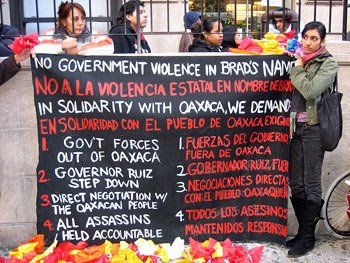
Moisés released a follow-up communiqué this July reporting on the results of preparatory encuentros held in Spain, Italy, Argentina, Germany, Canada, El Salvador, the United States, Brazil, and Uruguay. He encouraged the continuation of these gatherings and discussions and suggested that, for now, the Zapatistas and the Other Campaign have their hands full fighting to free the political prisoners of Atenco, participating in the popular rebellion in Oaxaca, and dealing with the fallout of the Mexican elections.
When and where the Encuentro of the Other Intergalactic will occur, and what it will look like, are questions still, with others, very much in play in these preparatory gatherings. How will the Other Intergalactic actually be different from the World Social Forum? The clear anti-capitalism and people power strategy of the Sixth Declaration provides some focus here. How can a truly global gathering be built equitably and in a way that makes it possible for all in attendance to participate? How can it be built from below? This, unfortunately, is a bit harder to imagine. In gatherings and events where these questions are being discussed, the Intergalactic network it proposes is already under construction.
Just as the Zapatistas’ Sixth Commission maintains a website for their participation in Mexico’s Other Campaign (enlacezapatista.ezln.org.mx), their Intergalactic Commission also has a website, “Zezta Internazional” (zeztainternazional.ezln.org.mx), where information is collected and distributed for the global network. It is through Zezta Internazional that people from 68 countries and every continent have signed on to the Sixth Declaration. It is there as well that the notes from preparatory gatherings are collected and international solidarity organized.
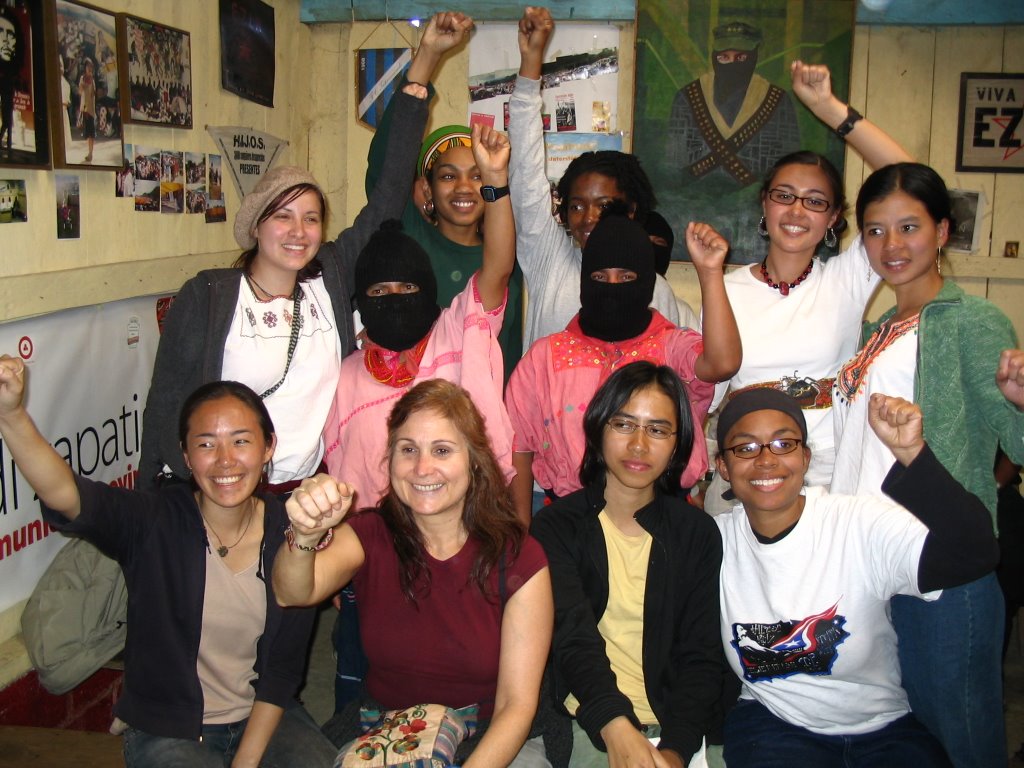
Just as the police attack on Atenco in May jumpstarted the action phase of the Other Campaign in Mexico, so it has the Intergalactic network as well. Immediately following the first reports of the attack on Atenco, solidarity actions began across the Americas and Europe. Solidarity actions in over 50 countries have been reported to the Intergalactic Commission. Representing for Africa and Asia, groups in South Africa, India, and Iran produced solidarity letters. Within the first month, US solidarity actions were reported in Albuquerque, Boston, Chicago, Houston, Los Angeles, Minneapolis, New York City, Portland, Riverside, Sacramento, San Antonio, San Diego, San Francisco, Santa Ana, Tucson, and Washington DC.
International proponents of the Sixth Declaration have begun as well to connect with and mobilize to defend one another. The fight against the displacement of the South Central Farmers in Los Angeles, for example, and to free Mapuche political prisoners in Chile being the two most visible instances of struggles amplified and supported by the Intergalactic process.
In addition to networking our local organizing at the national level, the US Social Forum could also be a space for education and analysis around the Zapatistas' Sixth Declaration of the Lacandon Jungle, for networking and strategizing amongst Mexicans and Chicanos in the US who are a part of the Other Campaign, and for those of us who are building the Intergalactic.
WHAT IS POSSIBLE?
Last summer, the proposal for the Other Campaign, an anti-capitalist movement to change Mexico “from below and to the left,” appeared to many to be an impossible dream. Today, it is a powerful nationwide movement with proponents in every territory of Mexico and across the border. What the new Intergalactic movement will look like is just now beginning to take shape.
What is possible here in the US, the “brain of the monster” as the Zapatistas say? What can happen if we spend less time looking at the power struggles and debates being waged “up above,” indeed as little as possible, and spend more time listening to and nurturing what grows up “from below”? In 1969, before the Young Lords started listening to their neighbors in Manhattan’s El Barrio, did they ever suspect that doing trash pick-up would be the first step to building a popular organization? When the Panthers released their ten-point program in 1966, could they have imagined that they would become innovators in the world of medicine through their work on sickle cell anemia, or that in 1970 they would convene the original Rainbow Coalition to organize our own Revolutionary People’s Constitutional Convention? What amazing things indeed can happen when we take care to listen and to nurture what is growing up already “from below.”
In the spirit of rejuvenating our language, humbly inspired by the Zapatistas, let me end with something like a poem,
If the Other Campaign were a mirror and we looked into it, what would we see? We would see, I believe, what is possible, if we fight for it.
In the mirror that is the Zapatistas and the Other Campaign, I see a rebel movement of everyday people here in the US.
A movement that builds popular organization past the dead ends of the Non-Profit Industrial Complex and, needless to say, the Democratic Party.
A movement that frees discontent from the reductive trap of electoral politics and builds real alternatives.
A movement with centers in every city and town where everyone who is excluded is welcomed and has a chance to be heard.
A movement in which militancy is defined by actions of political integrity and commitment in spite of serious consequences.
A movement as network that says, “an injury to one is an injury to all”—and means it.
A movement that recognizes that the elites are not a unified and unstoppable force. In other words, that we can be strategic and win.
A movement of humble people and groups who see how each member holds a piece of the puzzle.
A movement that meets our need to connect to something greater…where spirituality is recognized as what it is, strength.
A movement that addresses conflict and contradiction not with punitive but transformative justice.
That being said, I see a movement that can also address its contradictions.
I see organizers who can listen more than they speak and have the integrity to “lead by obeying.”
I can hear our slogans, statements and whispered conversations. They sound less like rhetoric and more like poetry…
THANK YOU to Ashanti Alston, Steve Ankrom, Dan Berger, Jacob Blumenfeld, nora butler burke, Al Giordano, Juan Haro, Gavin Leonard, Ellen Louise, Michael Menser, Gabriel Sayegh, Ije Ude, Jonathan Wilson, and Ora Wise for their feedback on the first draft. I was able to incorporate some suggestions and not others, so any critique should be directed to me and not to those who were generous enough to give me their feedback. Special thanks to Matt Feinstein and Francesca Fiorentini, for creating a pamphlet out of this article, to Sara Kershnar for extensive feedback on related pieces, and especially to Trip McCrossin for meticulous editing and proofreading.
REFERENCES and RESOURCES
Below is a list of the sources, other than personal experiences or interviews, referred to in this piece. They are listed, more or less, in the order that they appear in the essay. If you want a more specific reference for anything referred to here, please feel free to be in touch.
Sixth Declaration of the Lacandon Jungle
The EZLN
The Narco News Bulletin
Laura Carlsen’s “An Uprising Against the Inevitable”
Ramor Ryan’s “A Carnival of Dreams and the Brazilian Left”
Peoples’ Global Action
The World Social Forum
Kolya Abramsky’s “The Bamako Appeal and The Zapatista 6th Declaration”
Rebeldia Magazine
Sujatha Fernandes’ “Beyond the World Social Forum”
Luis Hernández Navarro’s “Chiapas and the Global Grassroots”
James Westhead’s “Planning the Long War on Terror”
Gary Alan Scott’s “The Rise of Fascism in America”
Josh Lerner’s “Why the World Social Forum Needs to Be Less Like Neoliberalism”
José De Córdoba and John Lyons’ “Mexican Rebel on Reality Tour” (Wall Street Journal, Jan 5, 2006)
James C. McKinley, Jr.’s “Marcos Back in the Public Eye in Mexico” (The New York Times, May 10, 2006)
RAND Corporation
Materials from “Network Training” by INCITE! Philly’s anti-displacement work group, the Media Mobilizing Project, and The University of the Poor (via Ora Wise)
Cincinnati Zapatista Coalition
Colectivo Situaciones, “Causes and Happenstance: Dilemmas of Argentina’s New Social Protagonism”
Marina Sitrin and Emilio Sparato, “New Languages and New Practices in Argentina,” Journal of Aesthetics and Protest
INCITE! Women of Color Against Violence
Estación Libre
El Kilombo Intergalactico
Ashanti Alston
Richard Flacks’ reply to a discussion re: his “Reflections on Strategy in a Dark Time”
US Social Forum
Project South
George Katsiaficas’ “Organization and Movement: The Case of the Black Panther Party and the Revolutionary People’s Constitutional Convention of 1970”
Read More!